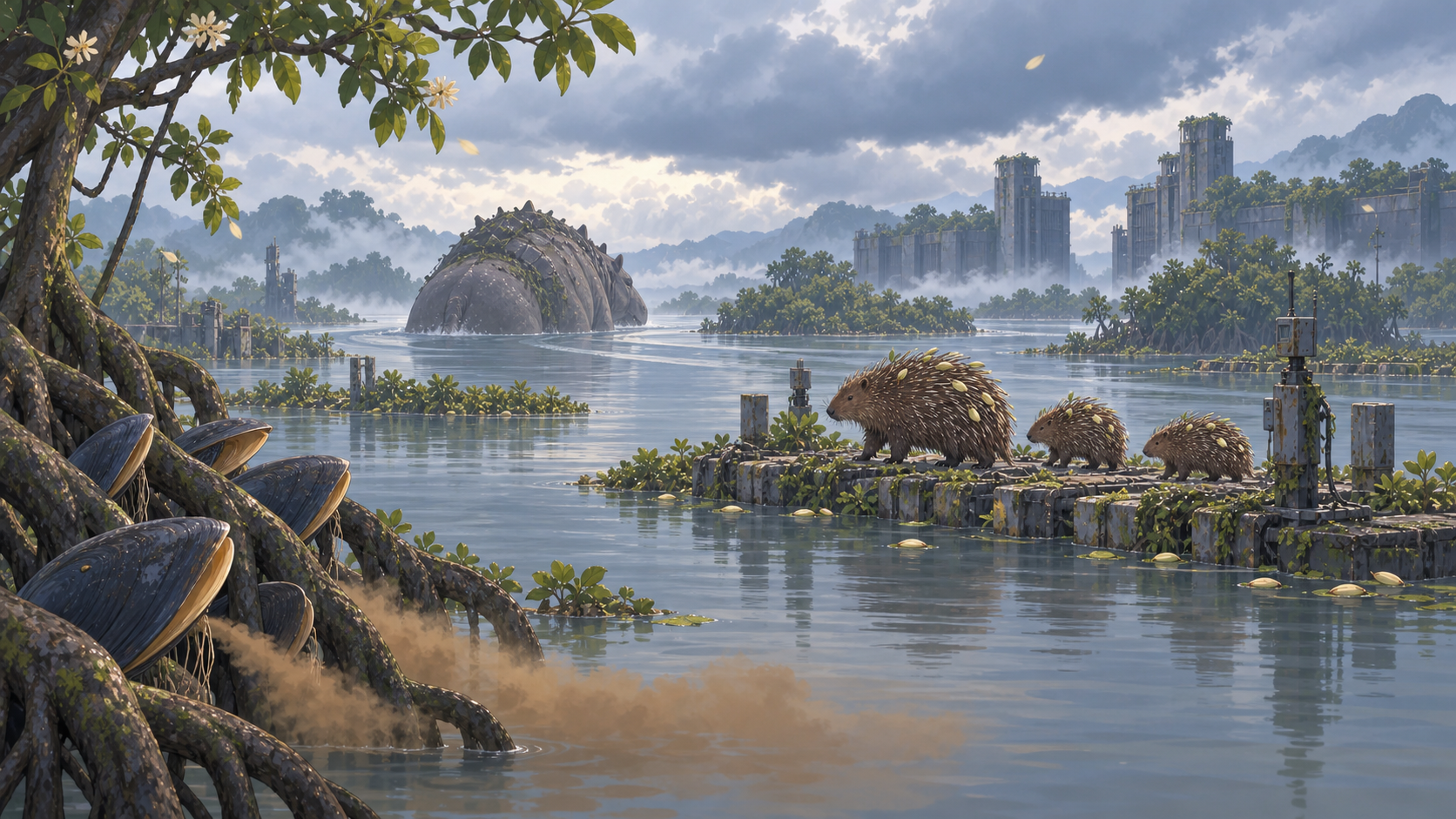
Rain-Vein Floating-Root Seedbank
This delta buffer changes its boundary between land and water every day. Mangrove roots have rewoven old farm ridges into floating islands. Detachable rafts preserve salt-tolerant crops and wild seed stock. Stilt towers, tidal gates, and the Calamity Spillway form a passable route only during short monsoon windows. Fresh and salt water, suspended silt, pollen, high-root nurseries, and deep-channel pressure together sustain a seed network that must remain mobile.
- Parent Domain
- NB-07 · Bengal Monsoon Labyrinth
- Location
- Outside the Seventh Monsoon Gate southeast of Bengal's floating-dyke city, spanning drowned farmland, Mangrove Root Islands, floating seed-bank rafts, and old river-channel sensors.
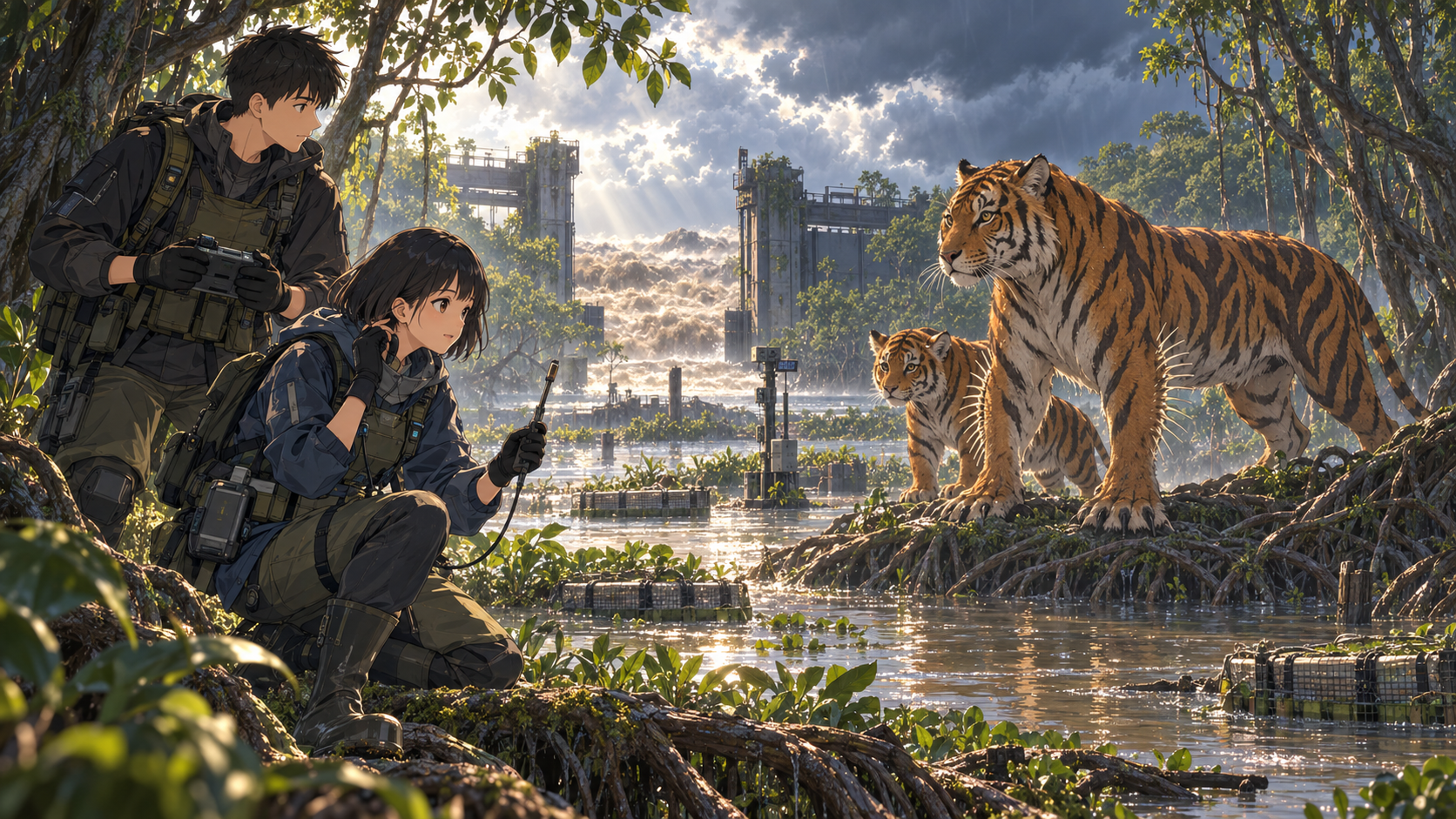
To prevent a super-monsoon backflow, the floating-dyke city started the Seventh Monsoon Gate's Low-Frequency Flood Pump too early. Its fixed sequence drove polluted silt into the mangroves, broke the seed rafts apart, and masked the pressure signals used by large animals. Mussels closed, porcupines and flying foxes stopped dispersing seed and pollen, and a mother tiger with her cub became stranded on a high-root island. Her pressure-sensing whiskers pointed to a still deeper anomaly: the pump rhythm was forcing a calamity-class hippopotamus toward the floating-root gates, where its pressure waves began to sink and tear the seedbank. Fang and K had to restore the tide's timing rather than remove any animal.
How Rain-Vein Floating-Root Seedbank Works
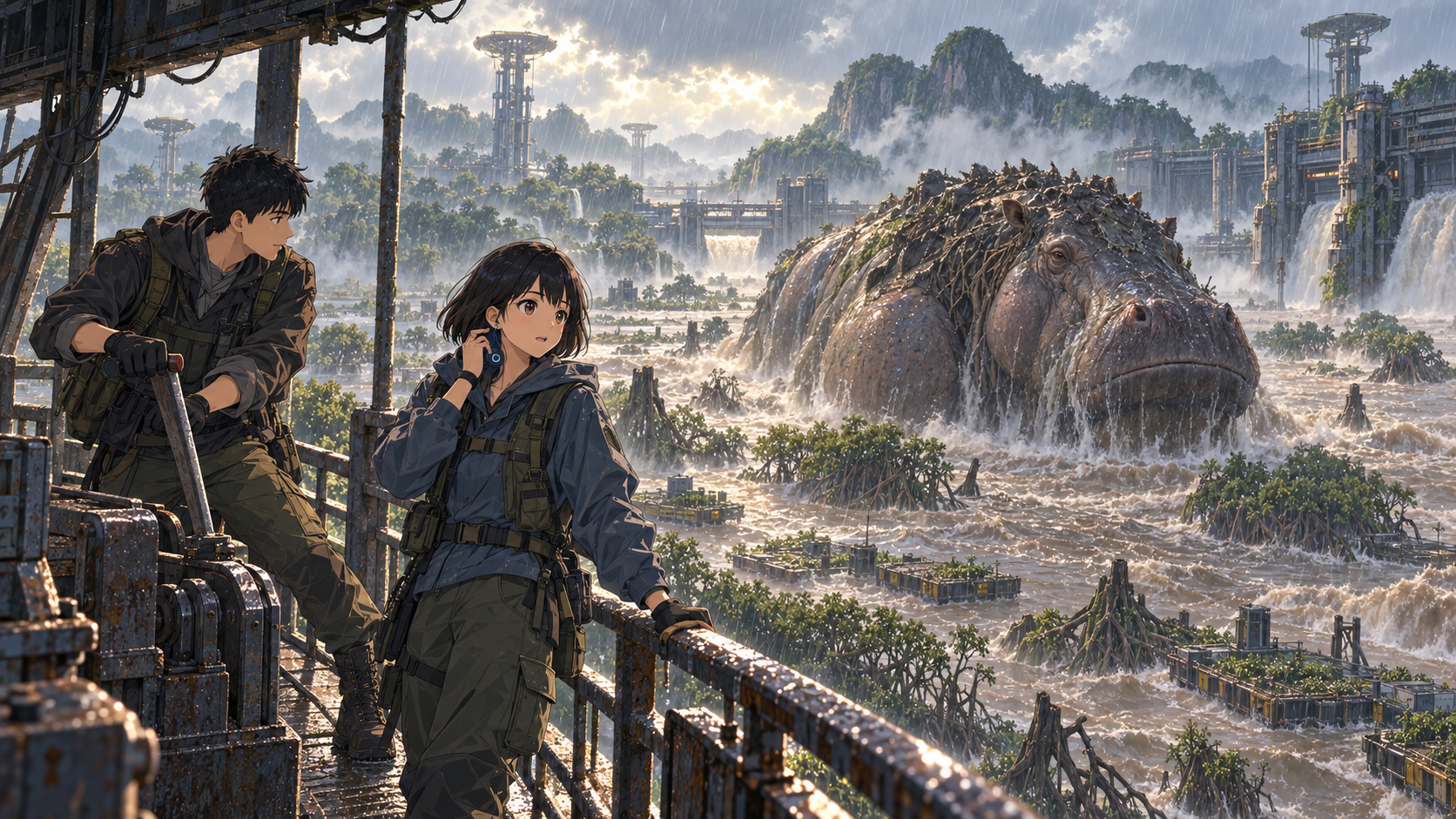
Rainfold Sail Mussels filter suspended particles and close nine seconds before a reverse pump surge. Floating-Seed Quill Porcupines carry buoyant seed between broken rafts. Monsoon Flower-Nosed Flying Foxes pollinate plants through stable canopy rain windows. A maternal Storm-Window Tide-Pattern Tiger limits how long the porcupines remain on one root island and reads tidal pressure with forearm whisker fans. The Breach-Tide Mud-Crown Hippopotamus normally follows the deep ebb channel away from the seedbank. Together, the five species connect water quality, seed movement, pollination, nursery territory, and the Natural Tidal Window.
Observation Ethic
Fang and K work outside nursery territories and chosen migration routes. They use passive sensors, keep active weapons stowed, preserve retreat lines, and collect only evidence the habitat has already released. They do not force mussels open, handle porcupines, redirect flying foxes, approach the tiger's cub, or drive the hippopotamus. They stop the false pump rhythm, reopen High-Root Nursery Corridor and Calamity Spillway, then allow every species to choose its own route.
Five-Day Route
- Use the mussels' synchronized closure at East Rain-Gate Root-Filter Bay to identify the artificial reverse surge.
- Follow the porcupines' concentrated caches from First Floating Seed Raft to the break in the mobile seed network.
- Read the flying foxes' detour through Flower-Nose Rainforest Window to locate resonance in the stilt-tower supports.
- Stay outside the maternal tiger's territory at Storm-Window Tiger Ridge, reopen High-Root Nursery Corridor, and use her forearm whiskers to find the deeper pressure source.
- Open Calamity Spillway and Returning-Tide High Gate, then stand clear while the hippopotamus follows the restored ebb channel away.
Five species maintaining this local ecology
 Day 01
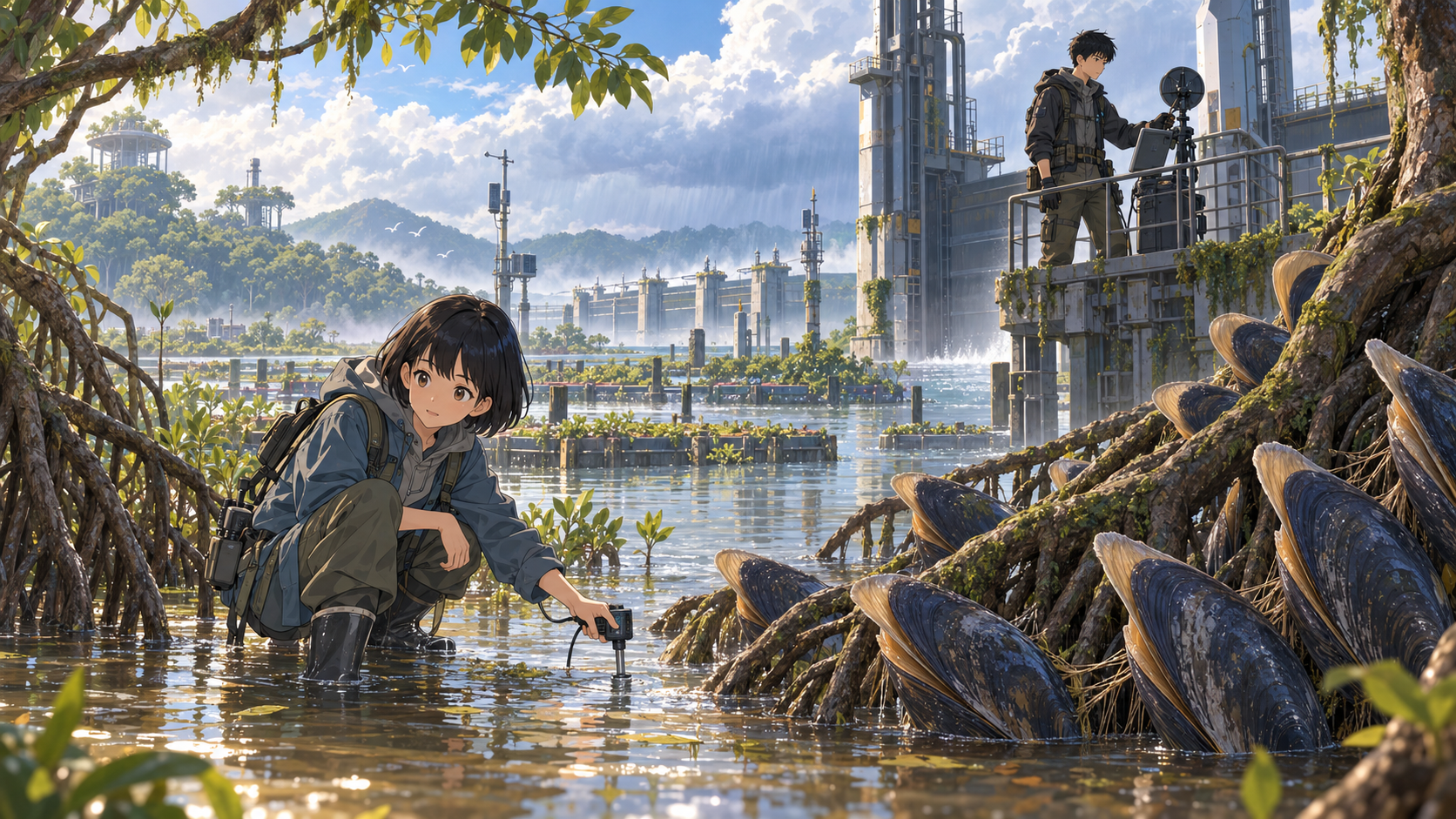
Rainfold Sail Mussel
The broad upper shell lip guides a gentle current into the gills. Before each reverse low-frequency pressure pulse, the pale amber mantle withdraws and the entire colony closes in sequence. The mussels stay shut while suspended silt covers the roots. When one pump segment is returned to the natural tidal range, individuals nearest the root crown reopen first, followed by the rest of the colony.
 Day 02
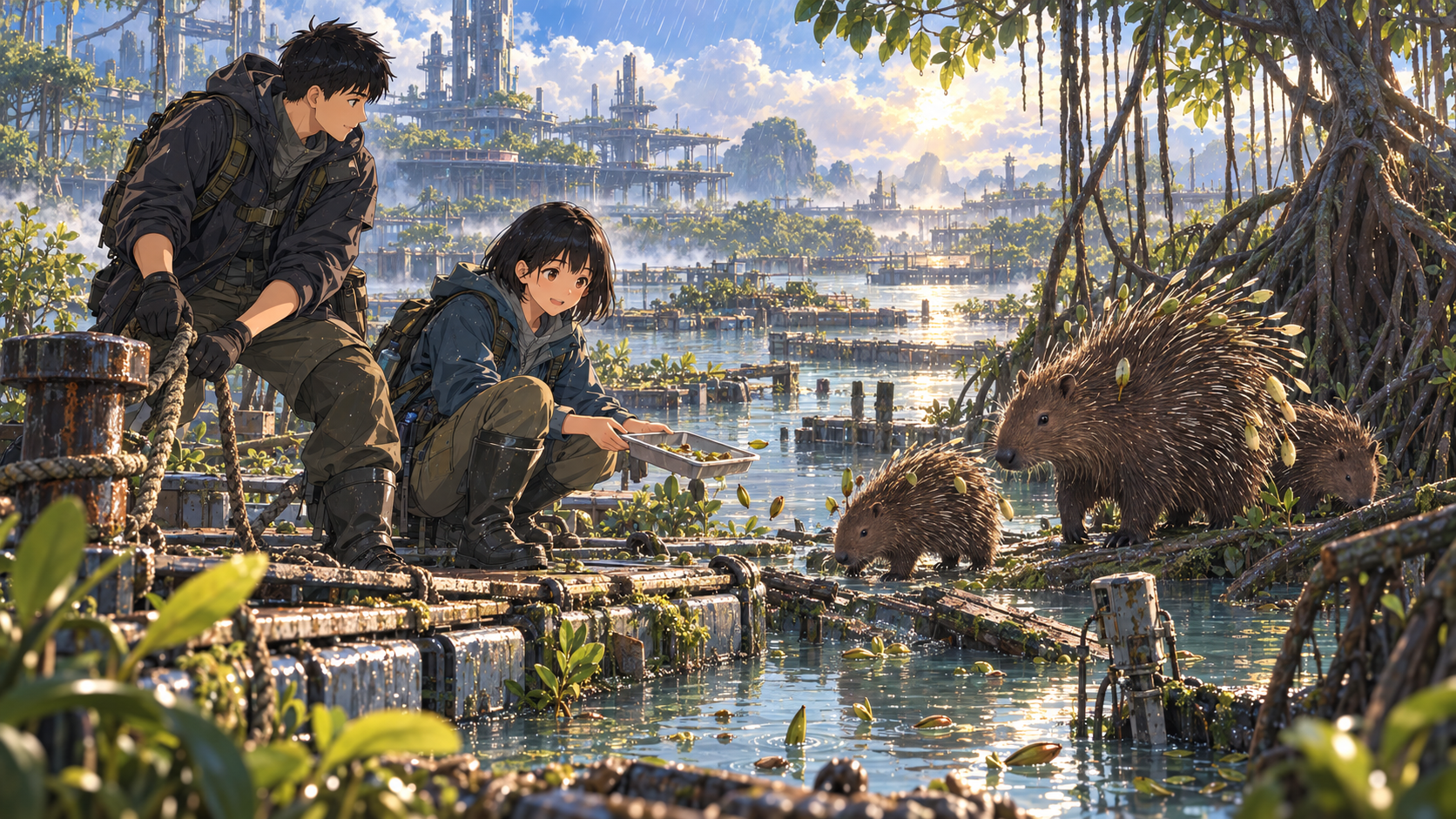
Floating-Seed Quill Porcupine
The broad, barbless ends of the chestnut quills pick up floating seeds without piercing them. Wide splayed toes spread body weight between rafts and wet roots. Families use raised mounds as seed caches and avoid root rafts destabilized by reverse flow. After the pump sequence slows and the rafts settle, they return without being driven and transport seeds across washed-out mud ridges.
 Day 03
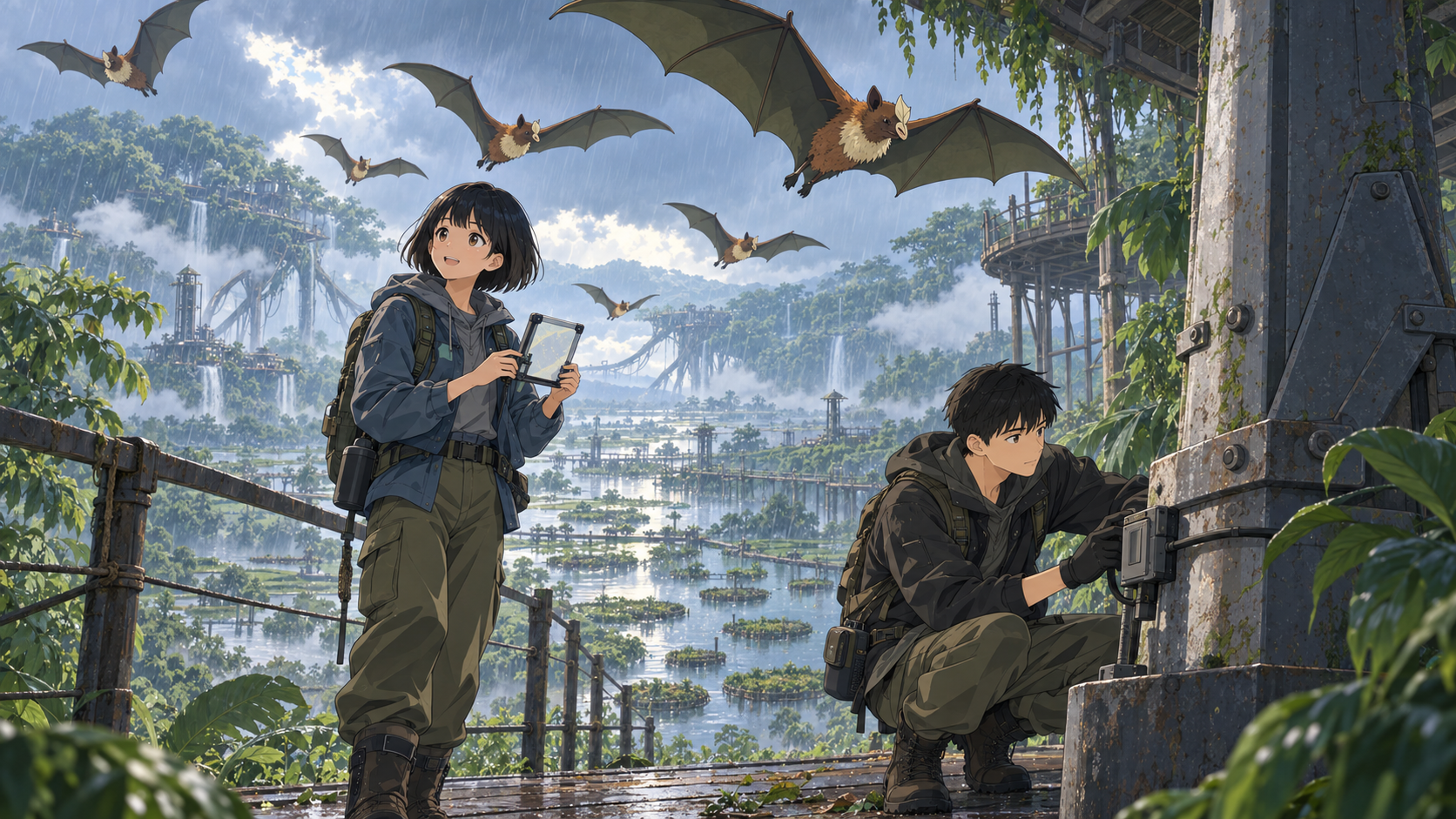
Monsoon Flower-Nosed Flying Fox
Groups glide low through gaps in slanting rain, using the stable wind pressure registered by their nose pads to hold a canopy route. Pollen collects naturally in the long chest ruff as they feed on nectar. When low-frequency vibration is amplified through a tower brace, the entire group detours around the seed vault. Once the brace is isolated, the bats return through the rain window and carry pollen back toward the floating seed rafts.
 Day 04
Storm-Window Tide-Pattern Tiger
The mother remains closed-mouthed beside her cub on the high-root line, opening the forearm whisker fans as pump noise distorts the pressure field. She does not pursue Fang or K. After the artificial route is reopened, the family withdraws on its own. Before leaving, she lowers the whiskers to the water and leaves a final pressure rhythm that points toward a much larger disturbance in the deep channel.
 Day 05
Breach-Tide Mud-Crown Hippopotamus
The animal rises beneath the Sinking Root Gate rather than charging it. Its immense back pushes the floating root island downward, and one breath draws the seed rafts into an arc. Every seventy-two seconds, the blocked spillway returns another pressure wave. When the fixed pump rhythm stops and the natural ebb enters the channel, the hippopotamus turns into the deep route and leaves under its own power.
「No animal caused the crisis. A city pump had overwritten the monsoon pressure field that connected all five species. After Fang and K stopped the fixed frequency and reopened the nursery and spill corridors, the hippopotamus left by the ebb channel, porcupines crossed the rafts again, mussels reopened, and the flying foxes recovered their pollination window. Repair did not mean controlling one species. It meant removing the human rhythm that had silenced the whole delta.」