Rain-Vein Floating-Root Seedbank is a five-day field route where Fang and K document a local ecology through observation, distance, and response.
Day 01 / 09.10
Nine Seconds Before the Alarm
Rainfold Sail MusselLow Risk
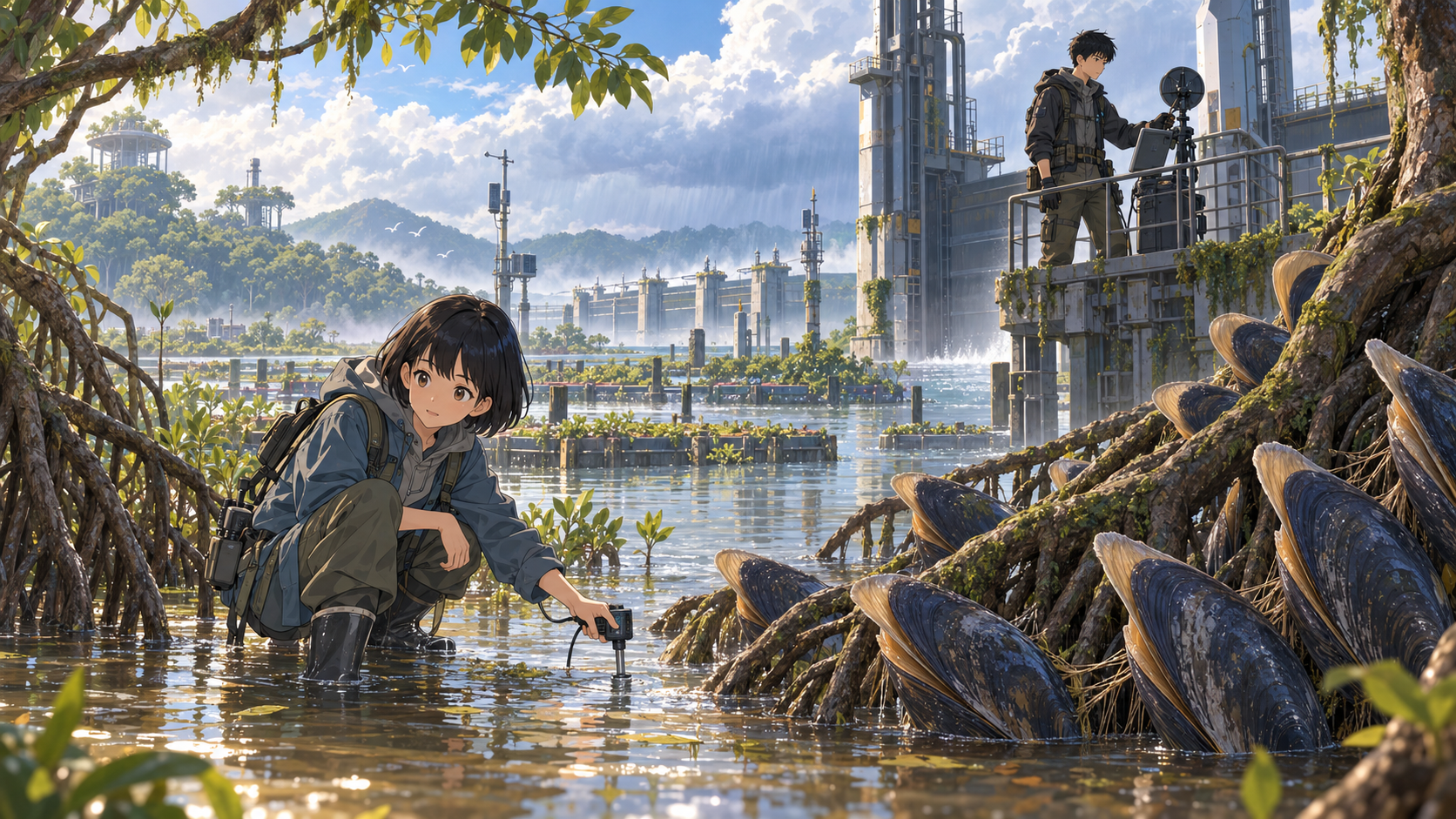
Rain at East Rain-Gate Root-Filter Bay did not fall straight down. Wind pressed it into diagonal lines along the floating levees. Fang and I descended to the edge of the root raft. Before the pumps made a sound, the Rainfold Sail Mussels folded away their broad shell lips together. Fang kept her distance, lowered a salinity probe into the outer water layer, and had me shut down active sonar. If the shells closed before the vibration, she said, they were sensing something other than sound.
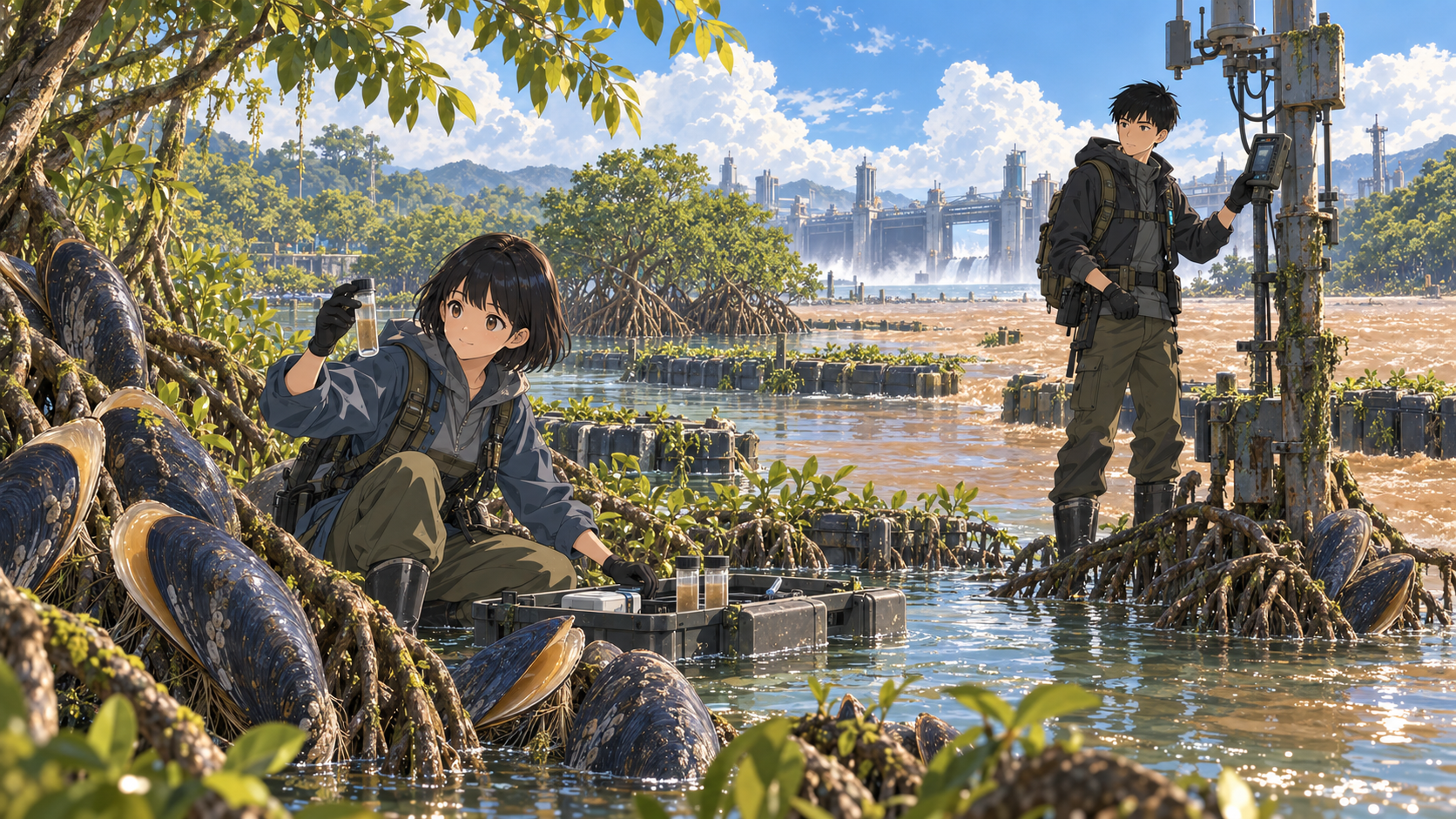
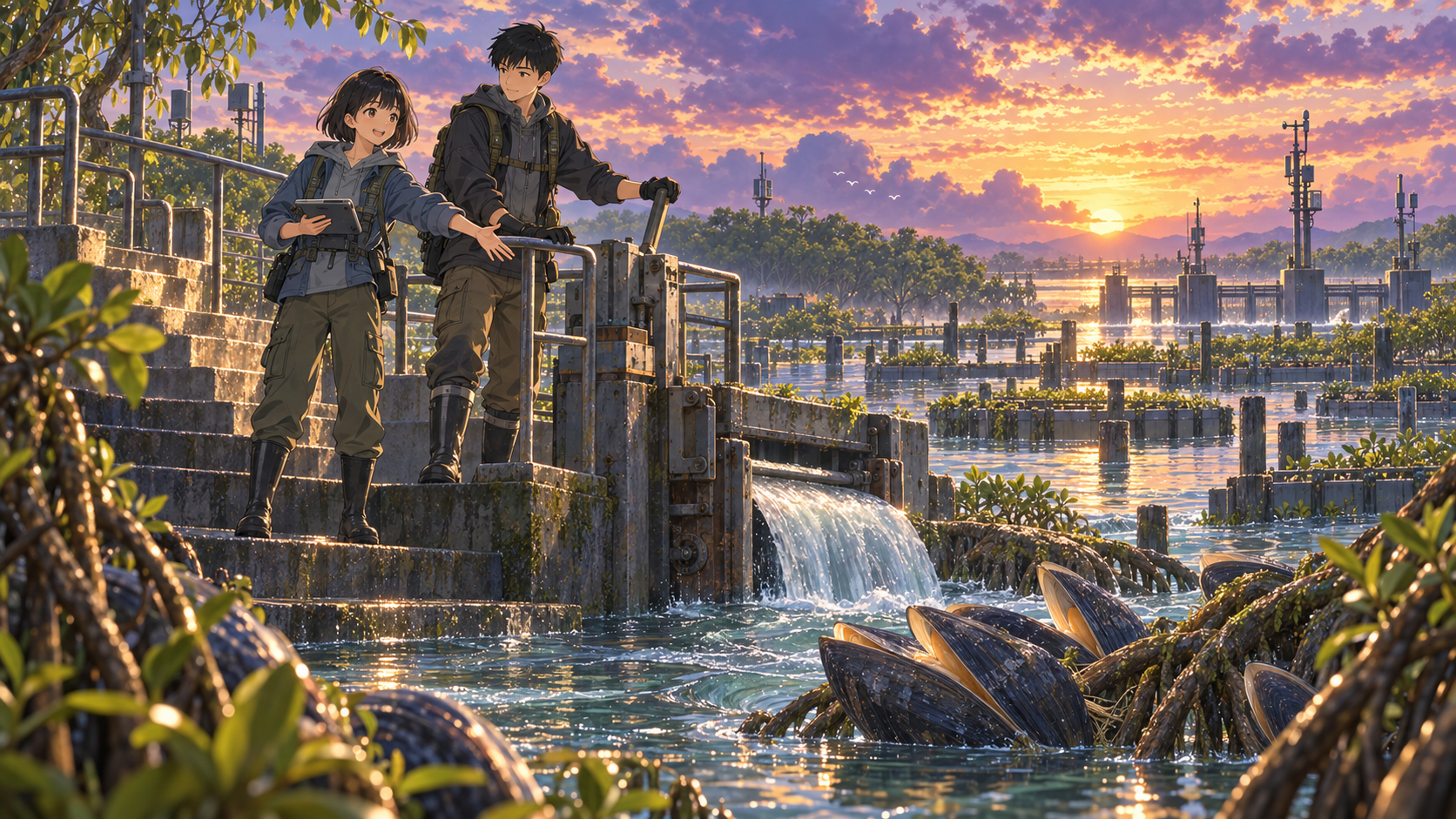
MORNINGI stayed on the old gate frame and recorded the gap between rising water pressure and shell closure. Every time the city prepared to raise flood pressure, the pale amber mantles withdrew into the indigo-gray shells first. The colony was not panicking. It was an alarm that woke before the old sensors. Fang asked whether we should let the pump keep following its schedule. I watched the water between the roots lose its exchange and stopped the automatic command before it was sent. The rain stayed heavy, and the mussels did not open for us. At least that night, we did not make them close again.NOONStopping the pump did not clear the water. It exposed a tea-brown layer of suspended silt moving backward into the root forest. Fang took three samples along the outer edge. I overlaid the mussels' closure rhythm on the surviving river-sensor record: once every twelve minutes, exactly matching the city's fixed flood-pressure pulse. The wide shell lips should have guided microcurrents into the gills. Instead they closed before every backflow, while mud film covered the anchoring roots. The contamination was not arriving from downstream. Our own pump was driving it back into the seedbank.EVENINGWe withdrew outside the gate steps and changed only the equipment people had left behind. Fang marked a narrow upstream belt where oxygen exchange still remained. I returned one pump segment from a fixed cycle to the natural tidal range, keeping both the bypass pipe and the colony's original filtration route open. Nothing changed after the first tide difference. As the water fell a second time, the mussels nearest the root crown showed their pale amber mantles. One after another, the broad shell lips reopened. We had not moved them or forced them to face another direction. The water had simply stopped breathing against the monsoon.
「Fang circled the breathing root bay on the map. We did not repair the mussels. We returned the rhythm our machines had blocked. I left the new pump sequence and warning line in place, with my weapon still behind my back.」— K
Day 02 / 09.11
The Route the Seeds Remembered
Floating-Seed Quill PorcupineLow Risk
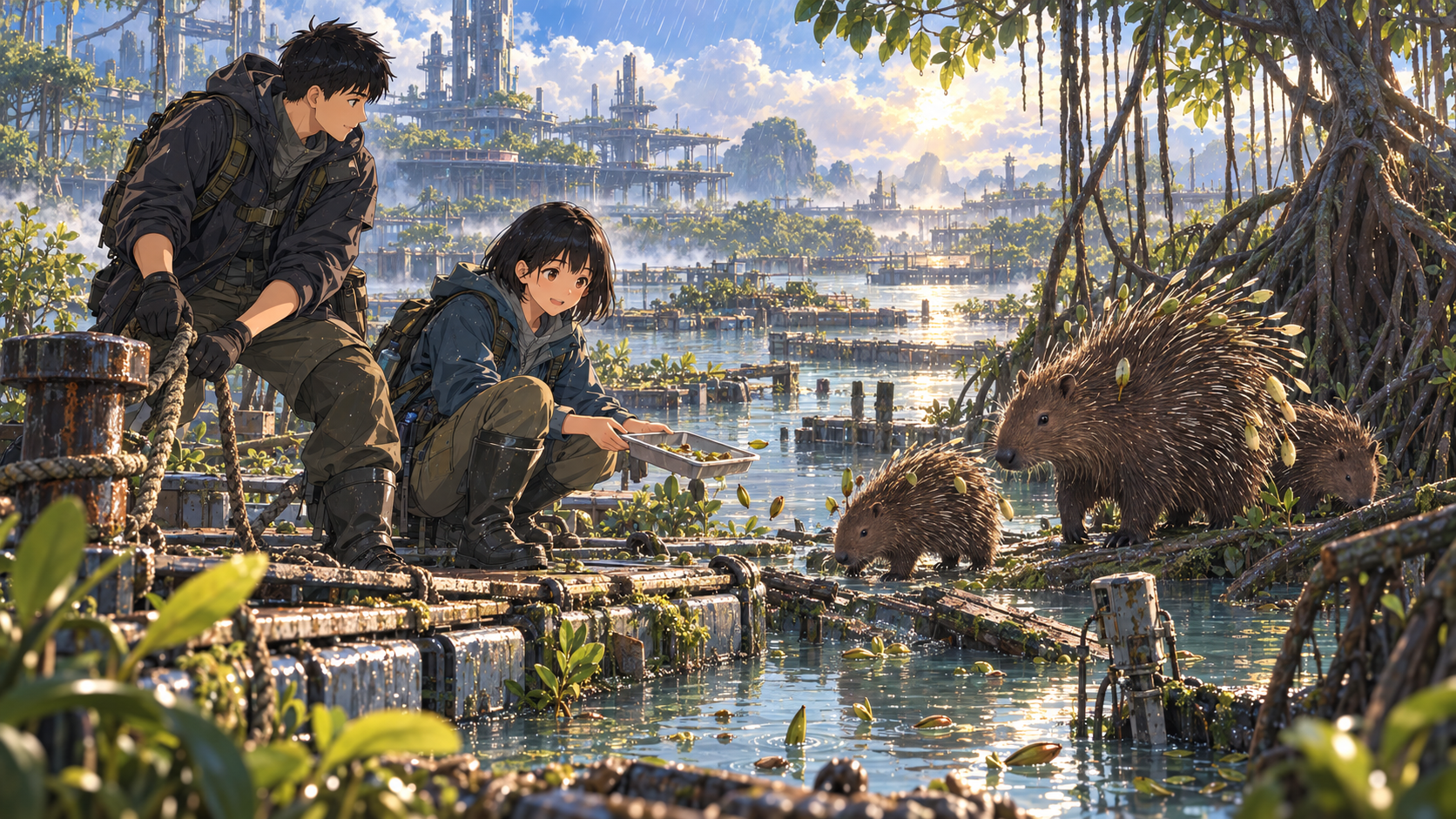
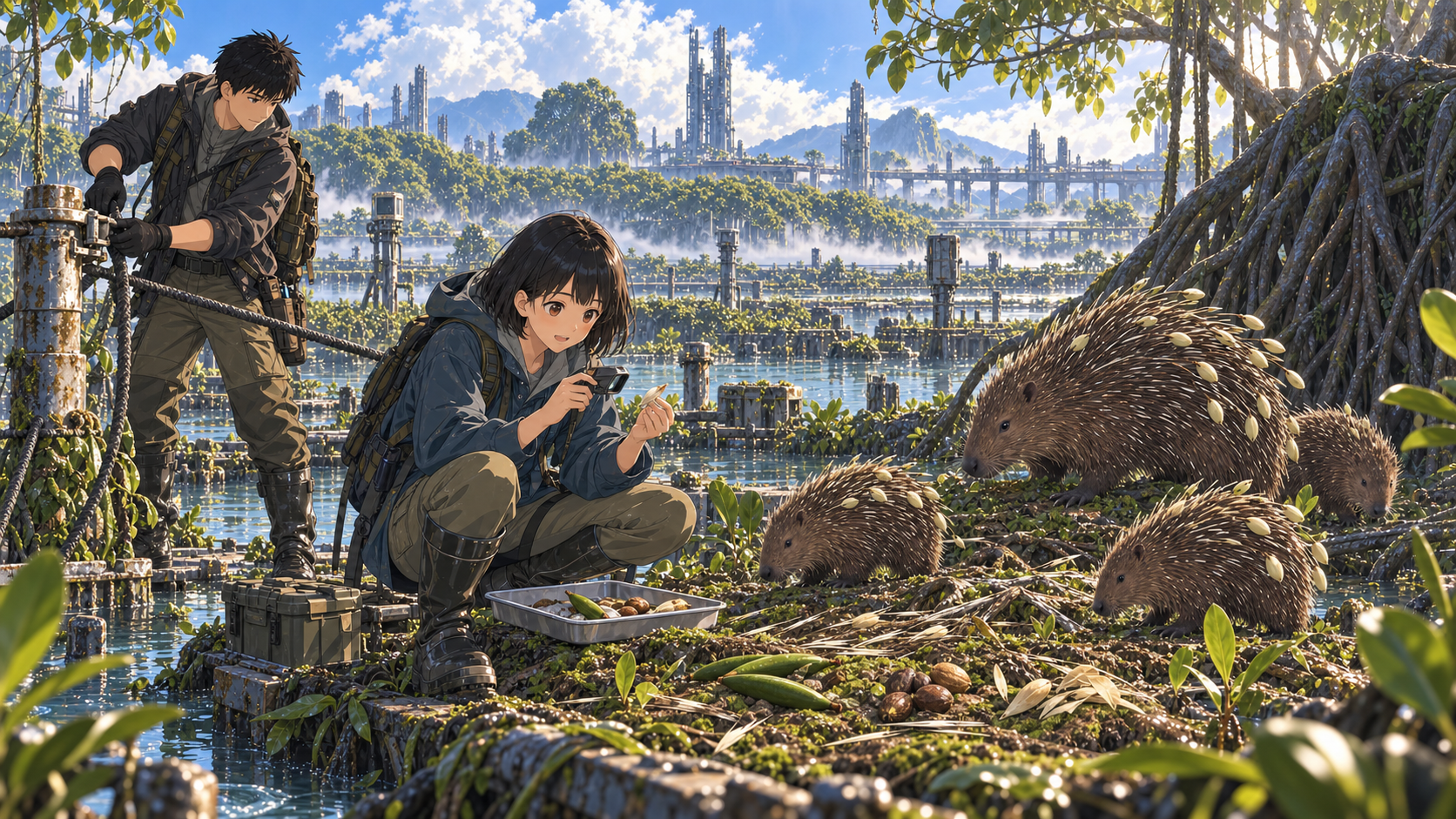
Rain pressure, root-raft height, and the old sensor readings were all changing at First Floating Seed Raft. A family of Floating-Seed Quill Porcupines carried floating seeds on broad, barbless quill tips, yet avoided the sections broken apart by reverse flow. Fang separated the quill-borne seeds, broad-toed tracks, and cache locations into repeatable evidence. I remained outside, marking load points, waterlines, and our retreat route. Every active weapon stayed stowed.
MORNINGThe porcupines did not treat every raft alike. Their tracks ended before the unstable sections, while seeds gathered on higher roots and intact platforms. The wide toes spread their weight across wet roots; the pale ends of the chestnut quills carried seeds without hooks. We stayed outside the family range and read the route from what the animals had left behind.NOONFang identified three kinds of mangrove seed carried on the porcupines' quills. She used a sampling tray to collect only seeds that fell naturally and did not enter the cache burrows. I fixed a loose artificial cable from the outside, without touching the mound. The concentration of caches on the raised embankment showed where reverse flow had made the lower raft network unreliable.EVENINGWe slowed the pump sequence and secured only the cables people had installed. As the root rafts settled, the family returned along them by choice, carrying seeds across a mud ridge that the backflow had scoured empty. We did not chase, move, or redirect a single animal. The route reappeared because the water and roots could hold still long enough for the porcupines to use it.
「We did not repair the porcupines. We removed the instability our equipment had put in their way. By dusk, their tracks and seeds crossed the empty ridge again.」— K
Day 03 / 09.12
The Corridor Hidden in the Rain
Monsoon Flower-Nosed Flying FoxModerate
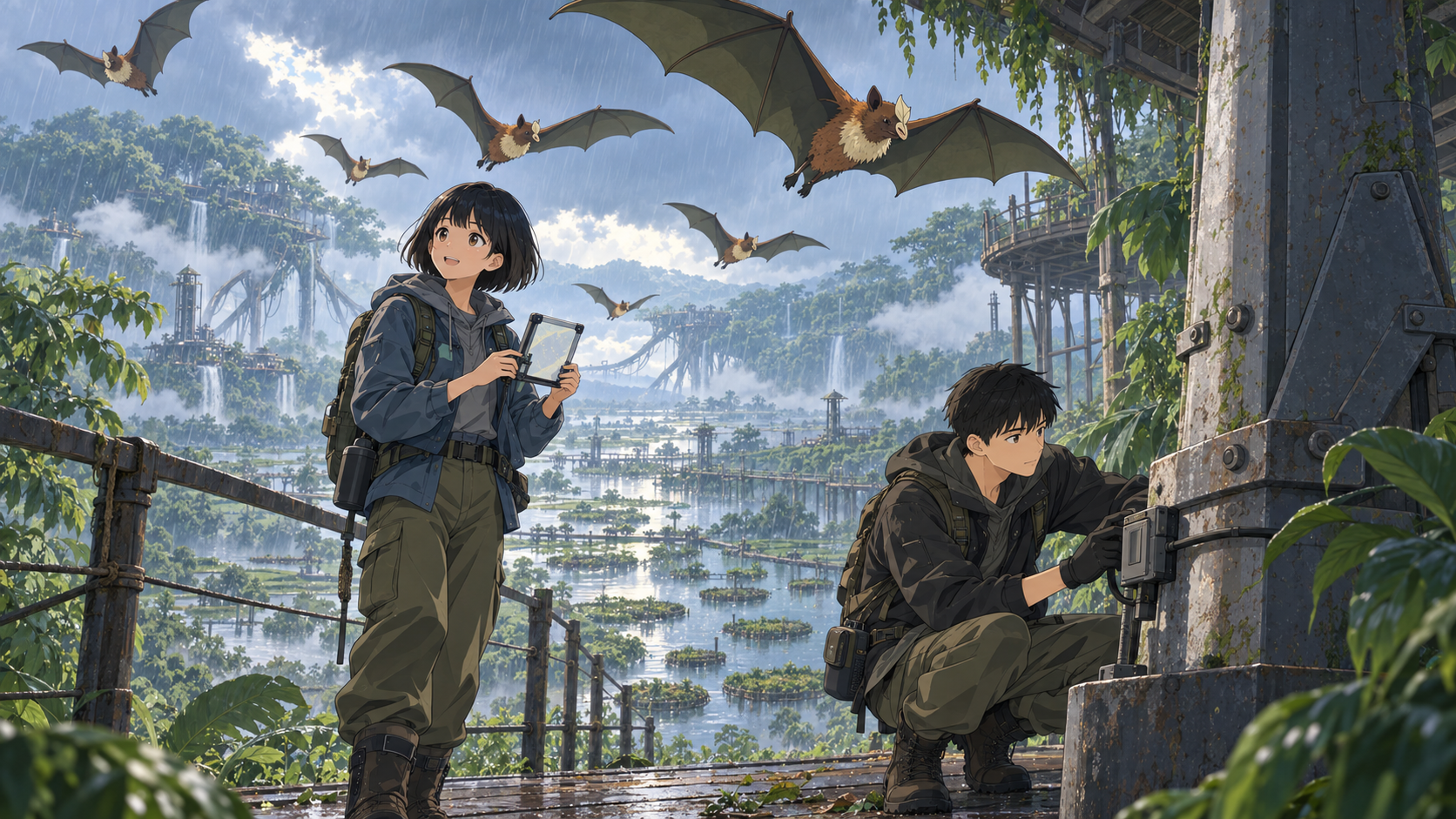
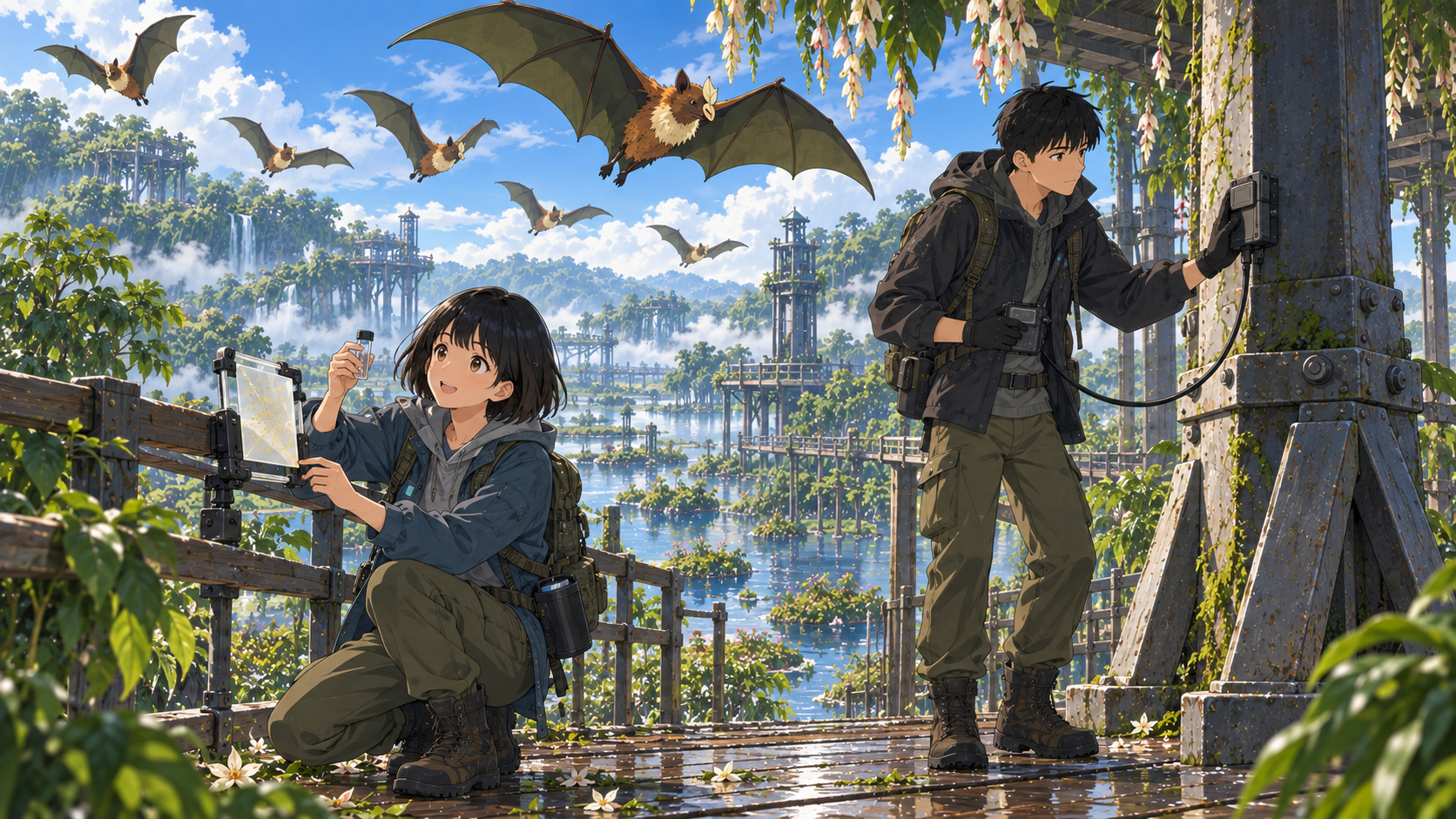
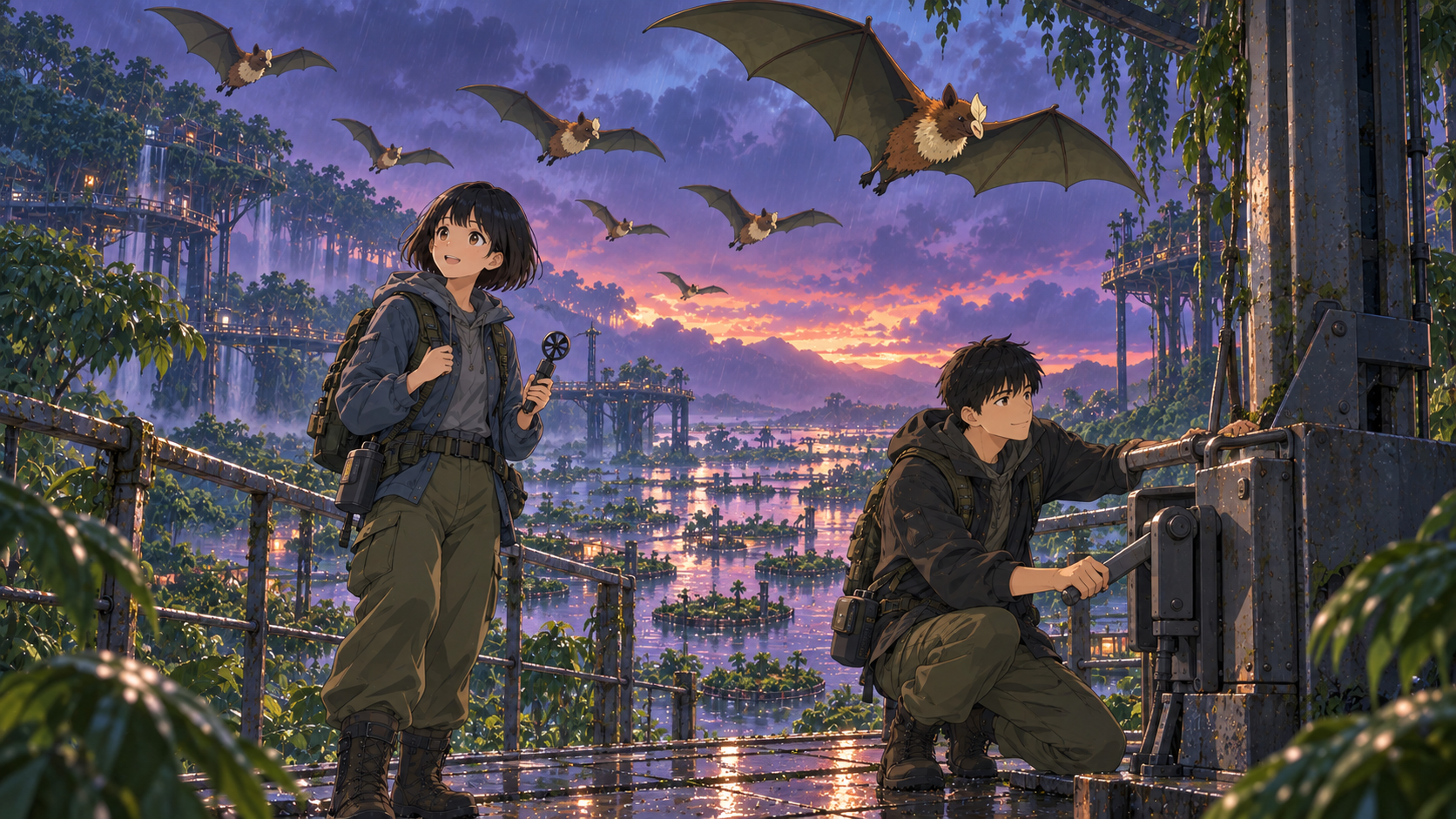
Rain pressure, root-raft height, and the old sensor readings were all changing at Flower-Nose Rainforest Window. Monsoon Flower-Nosed Flying Foxes glided low through the break in the rain. Their pale leaf-shaped nose pads registered the wind pressure, and their long chest fur carried pollen, yet the entire group turned away from the stilted seed vault. Fang set a thin sampling film beneath the route to catch only pollen that fell on its own. I stayed low at the tower footing and listened with passive instruments. The detour was not disorder. It was a reading.
MORNINGFang separated three forms of evidence: the nose pads' response to wind pressure, the sources of the pollen, and the flight line through the rain window. I marked load points, waterlines, and our retreat route from the outside. All active weapons stayed stowed. The bats passed safely overhead. We did not enter their airspace or ask them to change direction.NOONThe pollen film showed that the group had once used this canopy corridor to pollinate the seed vault. Fang collected only the grains already resting on the railing. I placed a passive vibration sensor against the tower footing and found the city's pump pulse traveling up an artificial brace, amplified through the structure. The bats had not abandoned the seedbank. Our equipment had turned their route into noise.EVENINGWe isolated the faulty resonant brace and changed nothing in the animals' route. Then we withdrew. When the frame quieted, the flying foxes crossed the canopy rain window again, carrying pollen in their chest fur toward the floating seed rafts. We did not close the rain or call the bats back. We removed the interference and let the corridor return.
「Repair sometimes means removing what people added. The flying foxes remembered the rest of the route without us.」— K
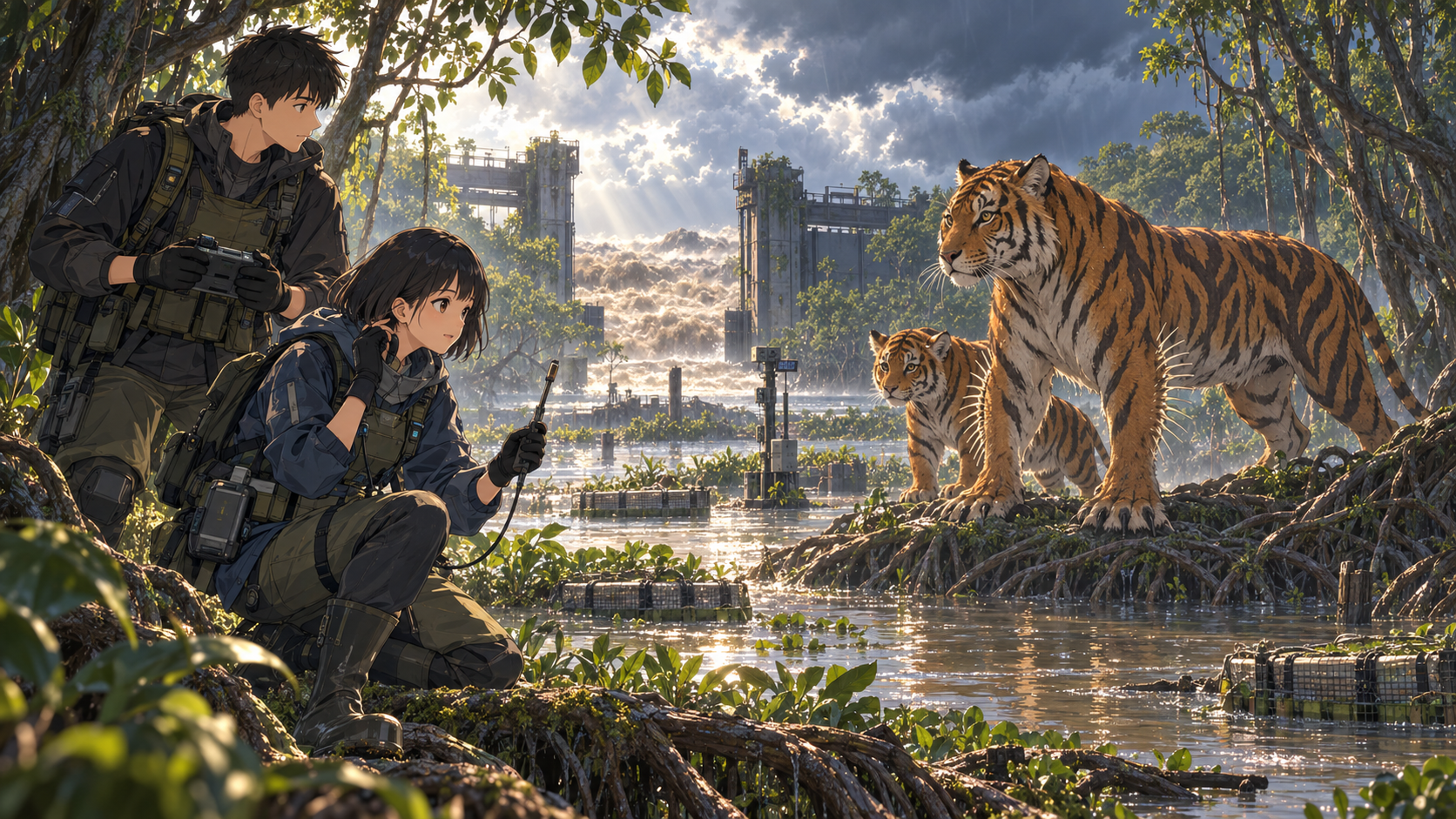
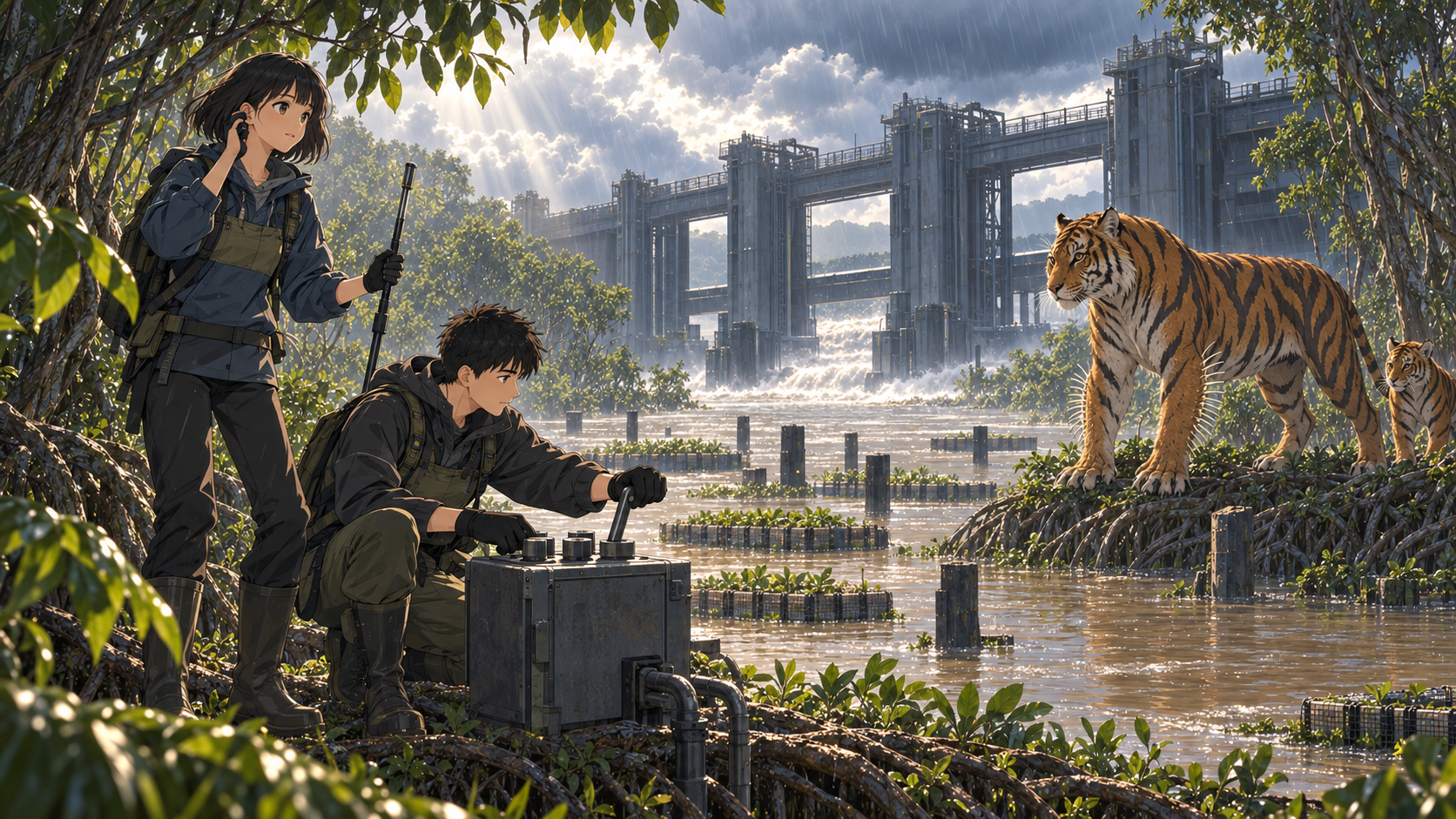
Rain pressure, root-raft height, and the old sensor readings were all jumping at Storm-Window Tiger Ridge. An adult female tiger and her cub held position on the high-root island. The whisker fans along her forearms stayed open against the gate-pump noise, while a ridge of muddy water began to rise in the distance. Fang separated the opening and closing of those whiskers, the placement of the webbed paws, and the nursery retreat route into repeatable evidence. I marked load points, waterlines, and our way out from the perimeter. Every active weapon stayed stowed. She did not pursue us. She warned the whole mangrove forest that the real pressure was waking below the water.
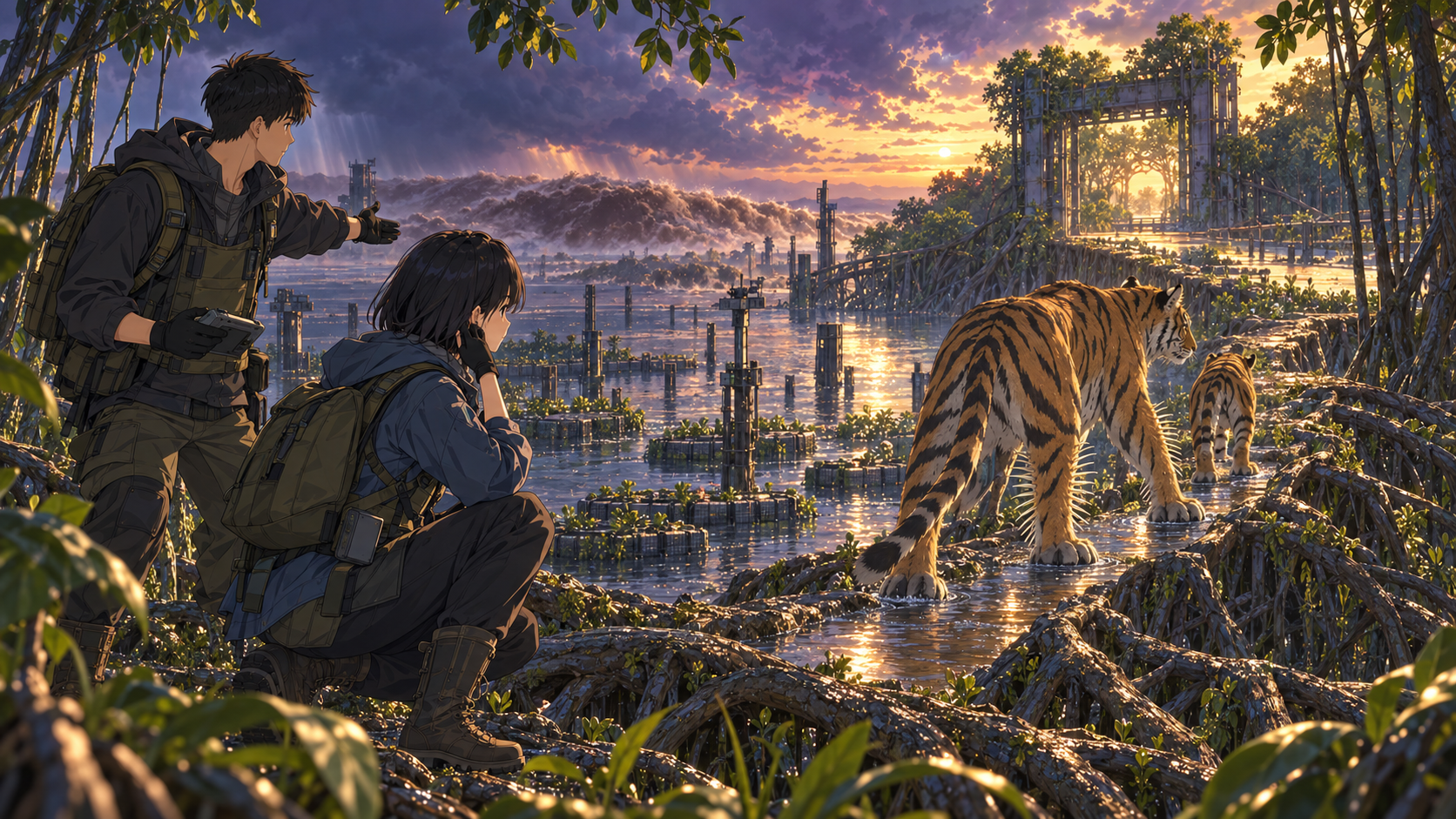
MORNINGThe mother kept her mouth closed and her body between the cub and the floating-dyke city. We stayed outside her markers. Fang read each change in the forearm whiskers against the rain and pump cycle. I checked the wet roots beneath us and kept the extraction line clear. The tiger was not advancing. The pressure field around her was being forced open.NOONThe metal braces hummed along the back of the gate. Fang used her BCI to separate thunder, tidal pressure, and pump frequency. I confirmed that the strongest pulse came from a deeper channel, not from the tiger's route. She remained beyond the high-root line, guarding the cub. She was not the destination. She was the alarm. If the fixed pump sequence kept driving muddy water backward, the next body to surface would belong to another scale entirely.EVENINGAfter we reopened the corridor, the mother and cub withdrew from the floating-dyke city by themselves. She did not look back. She lowered the whiskers along her forearms to the water and left one final pressure rhythm. Fang said it was not the family's route. It was a heartbeat heavier, deeper, and more violent than the tiger. We followed it only with our eyes toward the far side of the monsoon gate, where the whole muddy channel lifted as if something immense had taken its weight from below.
「The tiger was never blocking our way. She was marking the point beyond which the water had already gone wrong.」— K
Day 05 / 09.14
A Calamity Returned to Its Tide
Breach-Tide Mud-Crown HippopotamusCalamity
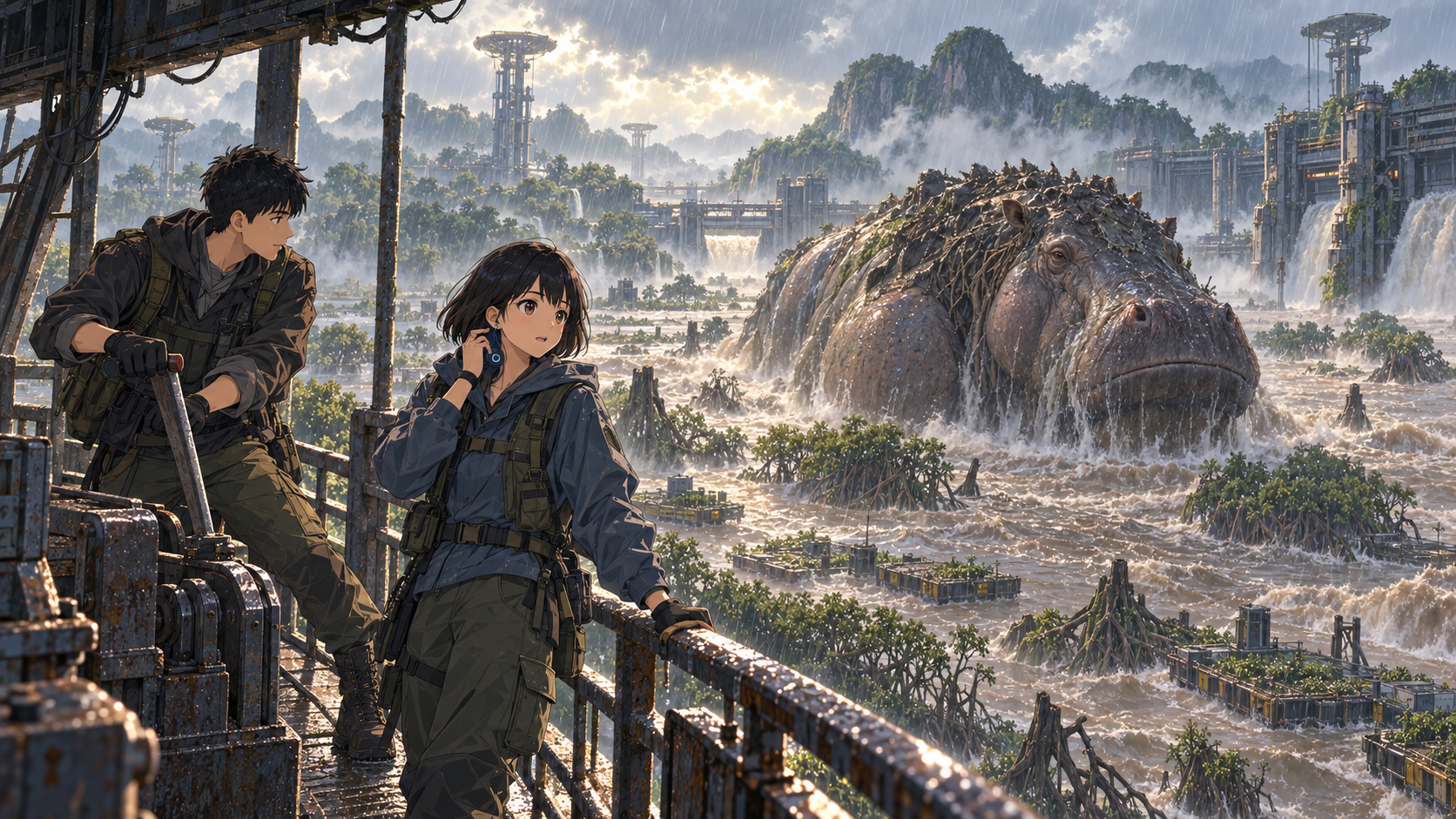
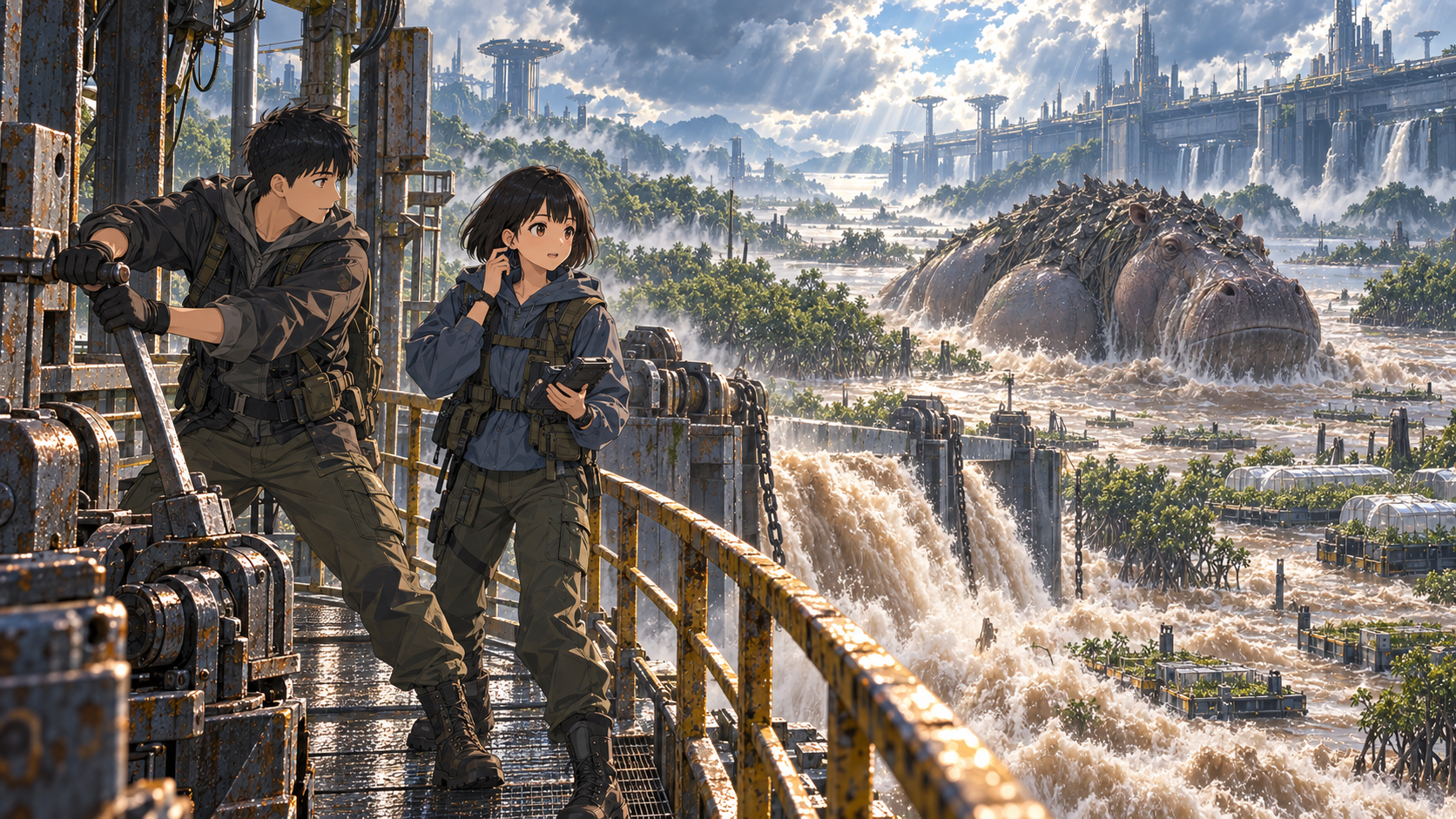
The water outside Sinking Root Gate was not rising. Something below was lifting it. When the Breach-Tide Mud-Crown Hippopotamus surfaced, its eighteen-meter back pressed the whole Mangrove Root Island downward. Black crown plates rose above the channel like the remains of a broken levee. It did not attack us. One breath was enough to bend a seed raft into an arc. This was not merely a high-risk animal. It was the center of a calamity-class pulse. As long as the fixed pump sequence kept driving muddy water backward, the entire seedbank would be pulled into its rhythm.
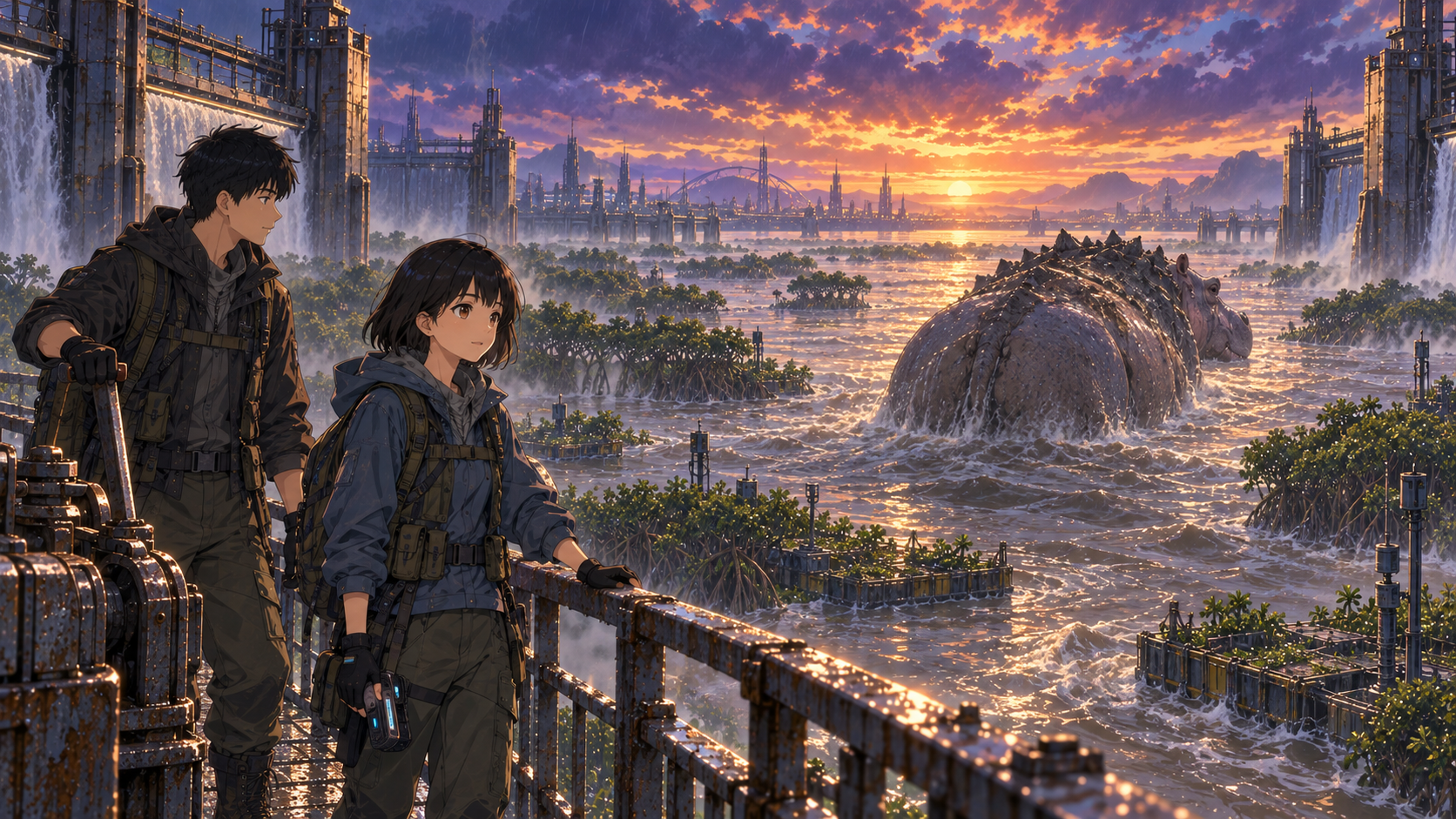
MORNINGThe hippopotamus surfaced beyond the gate. Its massive barrel body displaced the channel before it moved a limb, and the floating roots sank under the first surge. Fang read the pressure swelling in the mud-crown plates and flank sacs. I marked the maintenance platform, the spillway chain, and our retreat line. We kept our distance and every weapon stowed. The animal was not advancing on us. The fixed Low-Frequency Flood Pump was pushing it out of its deep-channel route and toward the seedbank.NOONThe spillway chain had jammed half open. The mud-crown pulse returned every seventy-two seconds. Fang used her BCI to separate thunder, pump frequency, and the animal's heartbeat. I drove the manual gate to its locked-open position so the water finally had somewhere to retreat. No weapon could solve a body of this scale. The false rhythm was the wall pushing it toward the floating-dyke city. We removed that wall and waited outside the channel.EVENINGThe high gate took in the first draw of the natural ebb. The hippopotamus turned into the deep channel. Black mud slid from its crown plates, and the Mangrove Root Island stopped splitting. After it passed, a wake wider than a road remained on the water. Fang folded away her BCI without speaking. We had not conquered a calamity. We had returned it to the tide route it should never have lost.
「The calamity was not defeated. The water was allowed to remember where it could go.」— K
JOURNEY DISPATCH
Subscribe to K's Hunting Log
Follow Fang and K into a world that has not yet been understood.