Storm-Window Tide-Pattern Tiger
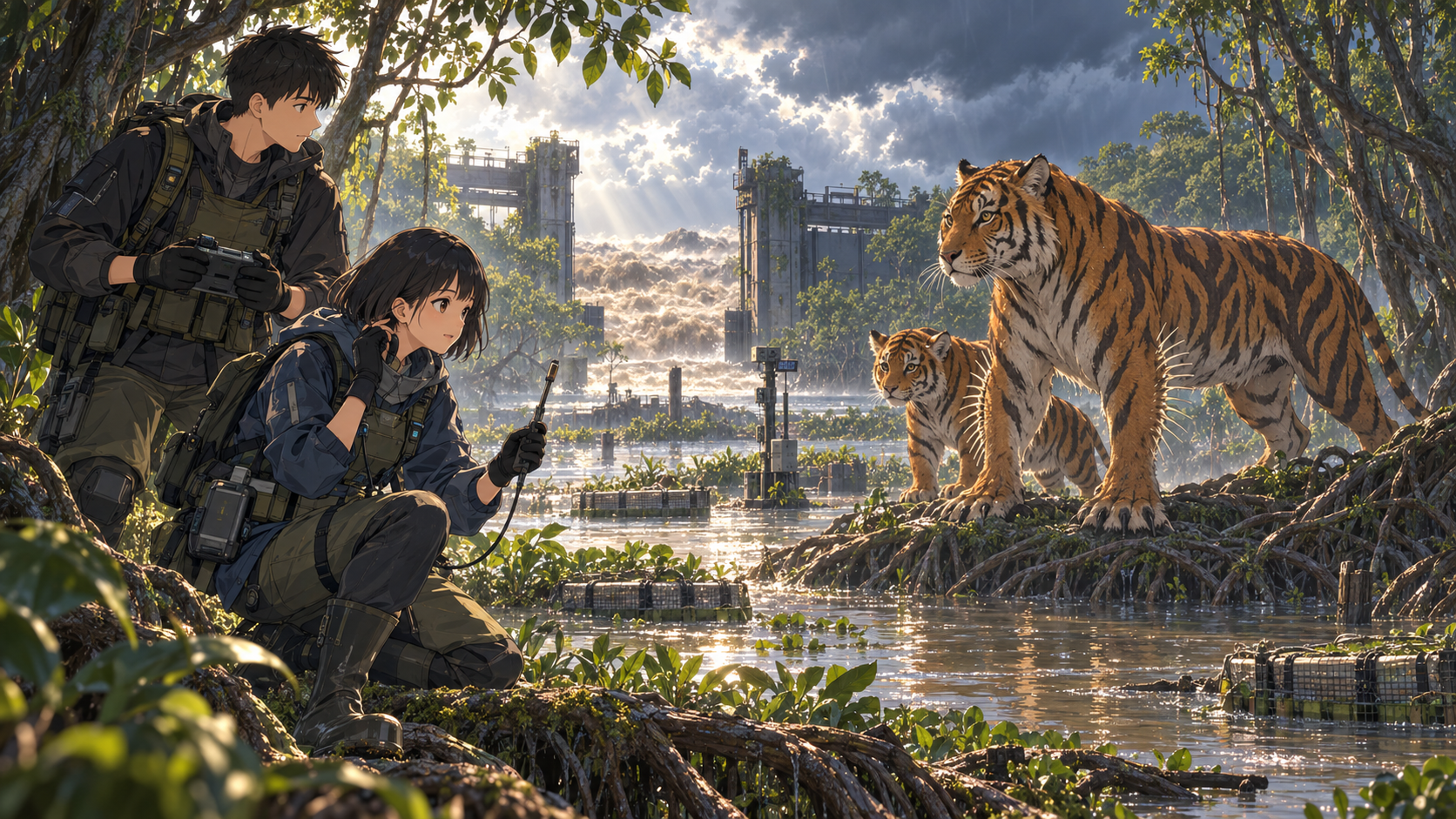
The mother remains closed-mouthed beside her cub on the high-root line, opening the forearm whisker fans as pump noise distorts the pressure field. She does not pursue Fang or K. After the artificial route is reopened, the family withdraws on its own. Before leaving, she lowers the whiskers to the water and leaves a final pressure rhythm that points toward a much larger disturbance in the deep channel.
Observation LevelCoastal field note
First SeenDay 04 · Day 04 · Storm-Window Tiger Ridge
HabitatHigh mangrove-root islands, floating dykes, drowned fields, and deep storm channels around the Seventh Monsoon Gate in the Rain-Vein Floating-Root Seedbank
VariantsJuveniles whose stripes have not yet branched, deep-ochre adult females, and a single mother-and-cub family
Habitat and Mechanism
High mangrove-root islands, floating dykes, drowned fields, and deep storm channels around the Seventh Monsoon Gate in the Rain-Vein Floating-Root Seedbank。The tiger's broad, partly webbed paws distribute its weight across wet roots, while short whisker fans on both forearms read pressure differences beneath monsoon rain. A female uses high-root islands as a nursery territory and closes off retreat routes when those readings become abnormal. The fixed flood-pump rhythm forced polluted muddy water back toward the mangroves and masked the Natural Tidal Window. Her open whisker fans also pointed to an abnormal Deep-Channel Pressure Wave, making her prolonged warning posture evidence of infrastructure failure rather than aggression toward the city.
Enter Rain-Vein Floating-Root Seedbank ↗Behavior and Ecological Role
The mother remains closed-mouthed beside her cub on the high-root line, opening the forearm whisker fans as pump noise distorts the pressure field. She does not pursue Fang or K. After the artificial route is reopened, the family withdraws on its own. Before leaving, she lowers the whiskers to the water and leaves a final pressure rhythm that points toward a much larger disturbance in the deep channel.
This apex territorial animal limits how long seed-carrying porcupines remain on any one root island. More importantly, its pressure-sensing posture distinguishes a reliable tidal window from an abnormal deep-channel surge. The tiger acts as the last regional warning before the calamity center reaches the seedbank.
Form and Identification
Juveniles whose stripes have not yet branched, deep-ochre adult females, and a single mother-and-cub family
- Biologically plausible giant-felid anatomy at approximately 4.5 meters in body length
- Deep ochre matte coat with broad charcoal stripes that branch like tidal channels
- Wide, partly webbed paws suited to wet roots and floating ground
- Short paired fans of pressure-sensing whiskers along both forearms
- Closed-mouth maternal territorial posture that preserves a clear retreat route for the cub
Observation Rule
Fang and K do not enter the nursery territory, chase the cats, aim, fire, touch, capture, or force either animal to move. Fang reads the pressure pattern from a safe distance. K works only on human infrastructure, keeps active weapons stowed, and maintains both the animals' retreat route and the team's extraction line. The family chooses when to leave.
At Storm-Window Tiger Ridge, an adult female and her cub held position on a high-root island while the forearm whisker fans stayed open against pump interference. Fang separated whisker movement, paw placement, and the nursery retreat route into repeatable evidence. K remained outside the territory, marked load points, waterlines, and an extraction route, and kept every active weapon stowed.