A Calamity Returned to Its Tide
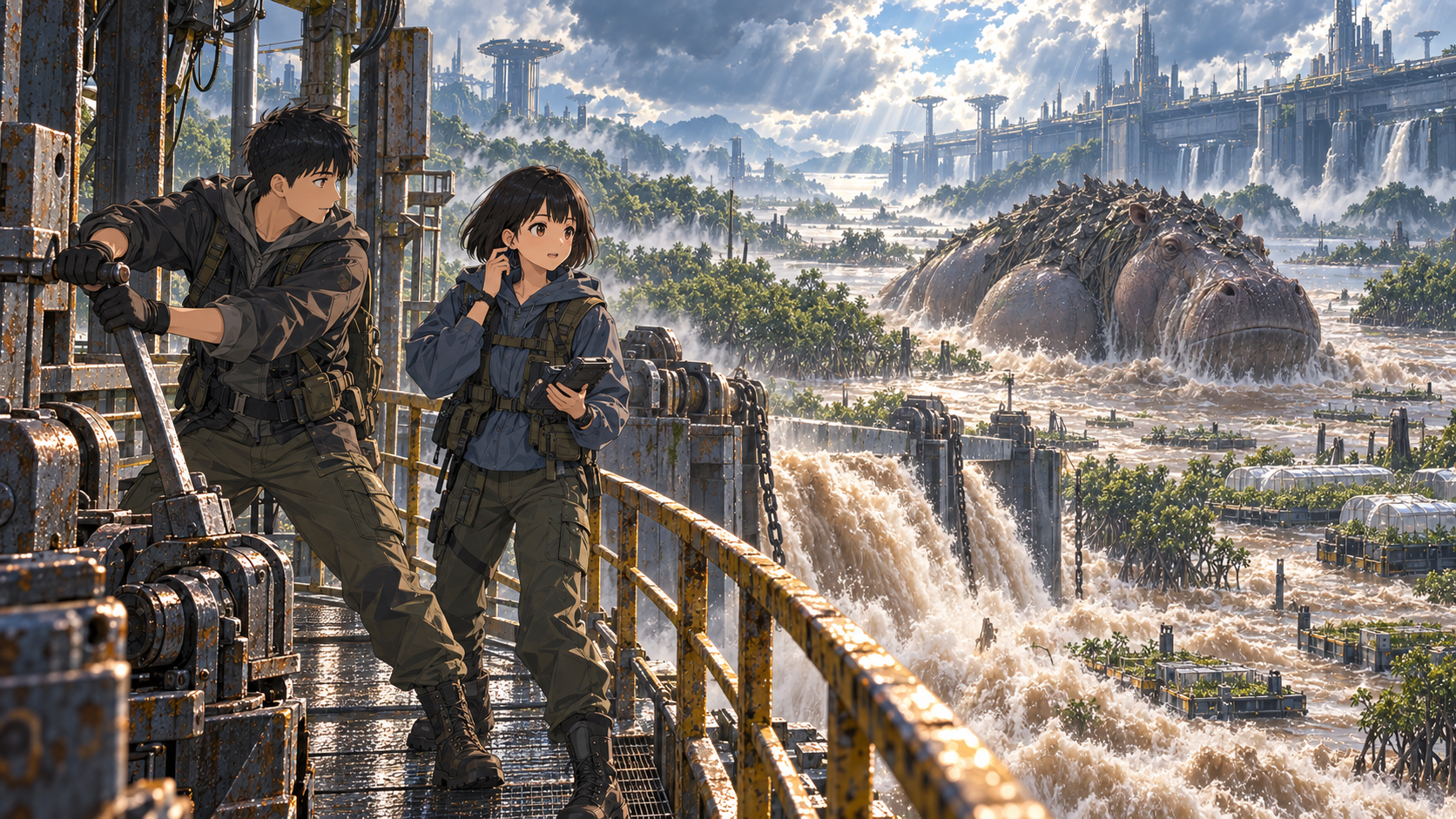
The water outside Sinking Root Gate was not rising. Something below was lifting it. When the Breach-Tide Mud-Crown Hippopotamus surfaced, its eighteen-meter back pressed the whole Mangrove Root Island downward. Black crown plates rose above the channel like the remains of a broken levee. It did not attack us. One breath was enough to bend a seed raft into an arc. This was not merely a high-risk animal. It was the center of a calamity-class pulse. As long as the fixed pump sequence kept driving muddy water backward, the entire seedbank would be pulled into its rhythm.
Field Observation
We left High-Root Nursery Corridor for the monsoon gate's deep channel. At Sinking Root Gate, we identified the animal as the center of a calamity-class pressure wave. At noon, Fang separated its rhythm from thunder and the fixed pump frequency while I locked Calamity Spillway open. In the evening, Returning-Tide High Gate admitted the natural ebb, and we stepped back as the animal chose the deep channel out.
Morning · Sinking Root Gate
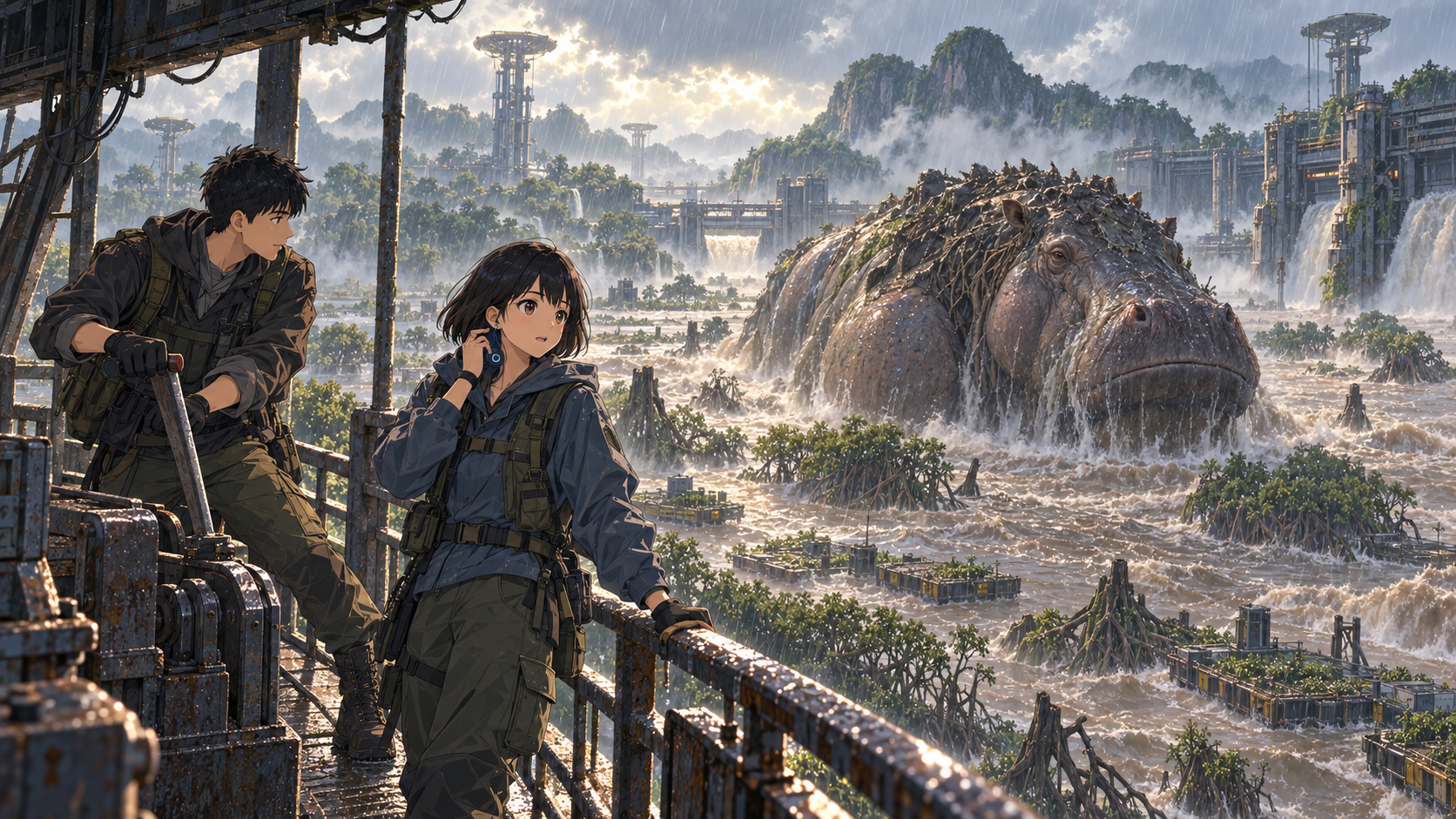
The hippopotamus surfaced beyond the gate. Its massive barrel body displaced the channel before it moved a limb, and the floating roots sank under the first surge. Fang read the pressure swelling in the mud-crown plates and flank sacs. I marked the maintenance platform, the spillway chain, and our retreat line. We kept our distance and every weapon stowed. The animal was not advancing on us. The fixed Low-Frequency Flood Pump was pushing it out of its deep-channel route and toward the seedbank.
Noon · Calamity Spillway
The spillway chain had jammed half open. The mud-crown pulse returned every seventy-two seconds. Fang used her BCI to separate thunder, pump frequency, and the animal's heartbeat. I drove the manual gate to its locked-open position so the water finally had somewhere to retreat. No weapon could solve a body of this scale. The false rhythm was the wall pushing it toward the floating-dyke city. We removed that wall and waited outside the channel.
Evening · Returning-Tide High Gate
The high gate took in the first draw of the natural ebb. The hippopotamus turned into the deep channel. Black mud slid from its crown plates, and the Mangrove Root Island stopped splitting. After it passed, a wake wider than a road remained on the water. Fang folded away her BCI without speaking. We had not conquered a calamity. We had returned it to the tide route it should never have lost.
Habitat Causality
The Rain-Vein Floating-Root Seedbank depends on brief natural exchanges between fresh and salt water. The fixed Low-Frequency Flood Pump masked that Natural Tidal Window, drove polluted silt back through the mangrove roots, and forced a deep-channel animal toward the floating gates. Its pressure waves then bent seed rafts and submerged root islands. Opening Calamity Spillway and Returning-Tide High Gate removed the artificial back-pressure. The natural ebb restored a route wide enough for the animal to leave by choice, allowing the mobile seed network to stop tearing apart.
Species Behavior
The eighteen-meter Breach-Tide Mud-Crown Hippopotamus is a semiaquatic megafaunal animal with heavy crown plates and pressure-sensitive flank sacs. It reads monsoon tidal differences through whole-channel displacement. A fixed opposing pump rhythm can misdirect it into shallower floating-root passages, where even breathing and turning create calamity-scale surges. When the deep ebb route is restored, it follows that pressure gradient away without being attacked, baited, or driven.
「The calamity was not defeated. The water was allowed to remember where it could go.」