Sulfur-Crown Tube Worm Colony
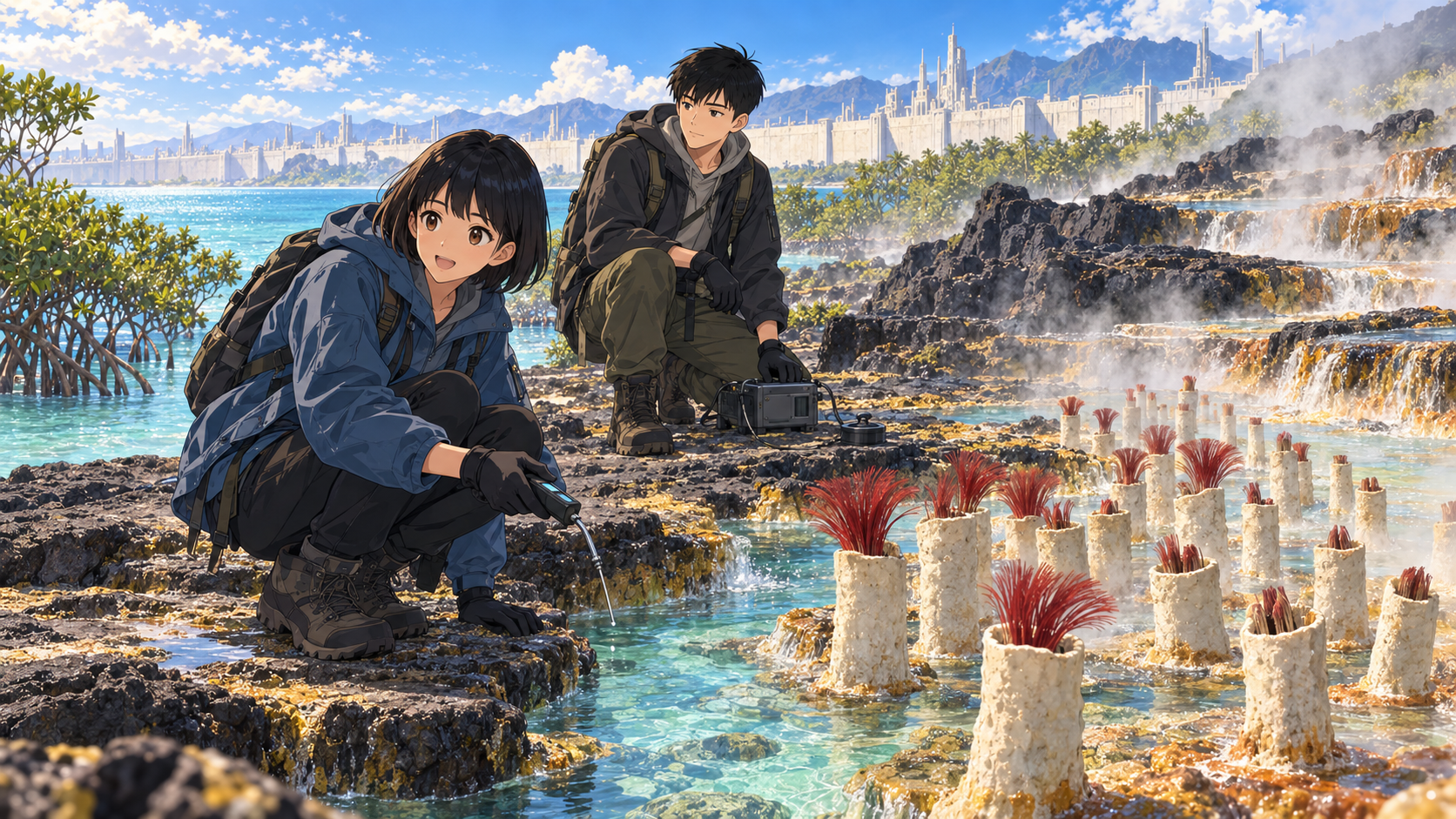
These annelids rely on symbiotic bacteria to absorb geothermal sulfides. Their porcelain-white mineral tubes remain fixed to the spring bank while the crimson branchial crowns retract before pressure rises. Retraction advances from the hottest end of the colony and gives the invisible brine movement a direction. After cool recharge water suppresses the hot brine, the crowns reopen from the outer edge in clustered succession.
Observation LevelCoastal field note
First SeenDay 01 · Day 01 · No. 9 Steam-Spring Basin
HabitatGeothermal spring banks, warm brine runoff, black-lava fractures, and salt-marsh margins within the Earthsong Cold-Spring Migration Gate
VariantsTranslucent larvae, adults in forty-centimeter ivory mineral tubes, and chemosynthetic colonies clustered along warm flow lines
Habitat and Mechanism
Geothermal spring banks, warm brine runoff, black-lava fractures, and salt-marsh margins within the Earthsong Cold-Spring Migration Gate。A Subsurface Cold-Water Lens should hold superheated brine below the root zone and keep the salt marsh cool enough for large animals to cross. Continuous pumping by the city's desalination wells thinned that layer and allowed hot brine to rise through new fractures. The colony retracted its crowns in sequence from the city side seventeen seconds before the alarm, revealing the direction of pressure change. Opening one section of the old gravity-fed recharge gate within the natural seepage range restored the cold-water boundary, and the outer colonies extended their crowns again without being moved.
Enter Earthsong Cold-Spring Migration Gate ↗Behavior and Ecological Role
These annelids rely on symbiotic bacteria to absorb geothermal sulfides. Their porcelain-white mineral tubes remain fixed to the spring bank while the crimson branchial crowns retract before pressure rises. Retraction advances from the hottest end of the colony and gives the invisible brine movement a direction. After cool recharge water suppresses the hot brine, the crowns reopen from the outer edge in clustered succession.
The colony converts geothermal sulfides through symbiosis and passively marks pressure and temperature boundaries across the spring bank. Its retreat line exposes the first route of hot-brine intrusion. Its return also confirms that the thermal boundary required by beetles, rhinoceroses, wild dogs, and giant bovids is becoming passable again.
Form and Identification
Translucent larvae, adults in forty-centimeter ivory mineral tubes, and chemosynthetic colonies clustered along warm flow lines
- Biologically plausible geothermal annelid tube worms in fixed colonies
- Matte ivory mineral tubes roughly forty centimeters long
- One restrained crimson branchial crown emerging from each adult tube
- Colonies clustered beside warm brine runoff rather than coral growth
- Sequential crown retraction before a pressure surge, with no tentacles or coral anatomy
Observation Rule
Fang and K do not touch, remove, relocate, stimulate, or reposition the tube worms. Fang samples only outside the colony. K disables active scanning, uses passive seismic records, changes only human pumping and recharge equipment, and keeps weapons stowed. The animals determine their own retraction and reopening sequence.
At No. 9 Steam-Spring Basin, the crowns began retracting before the pumping well could be heard. Fang left a temperature probe at the colony's outer edge. K disabled active scanning, used only a passive seismometer, and stopped the planned pumping command before transmission while every weapon remained stowed.