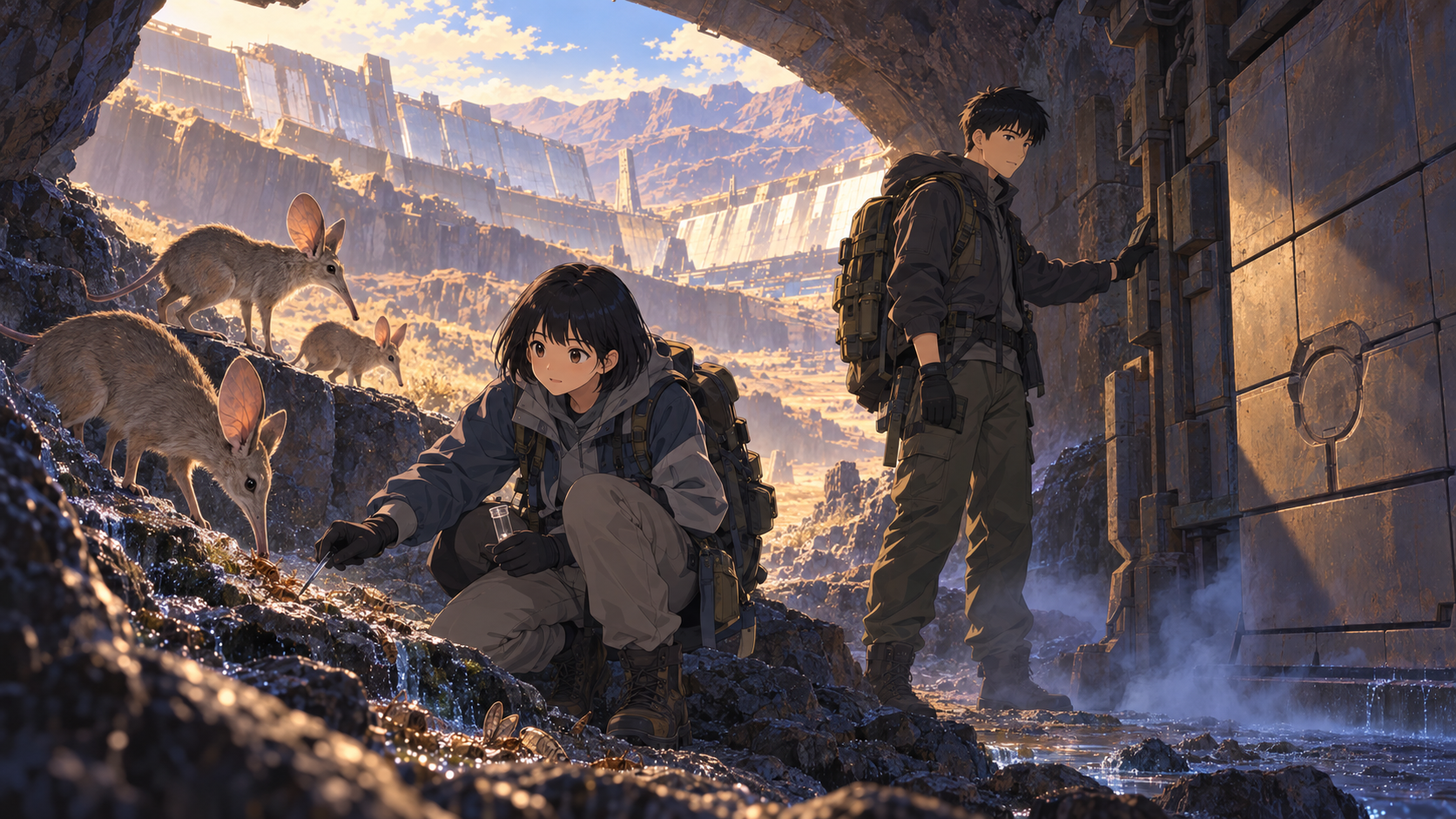
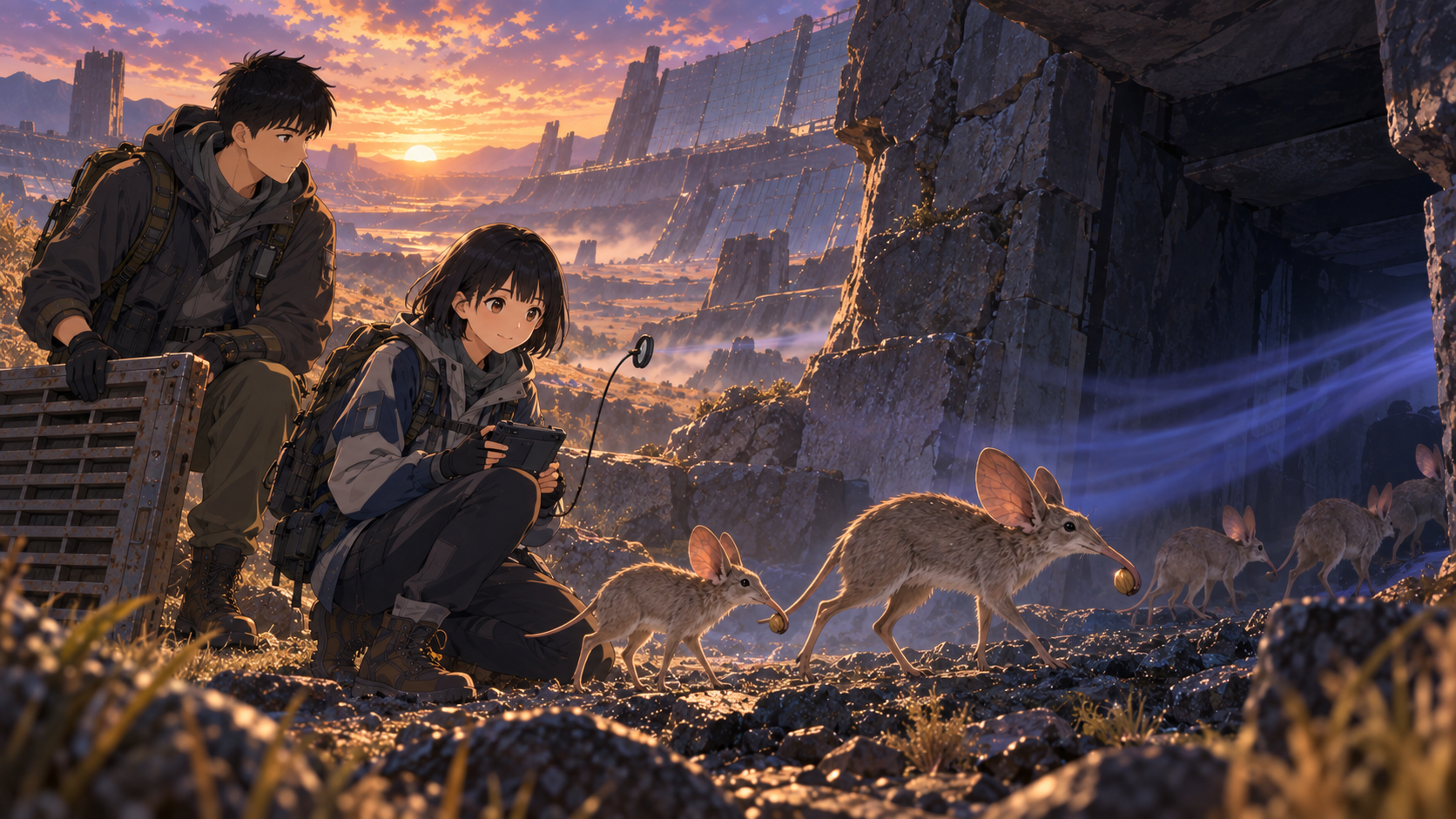
Lights-Out Cold-Well Corridor is a five-day field route where Fang and K document a local ecology through observation, distance, and response.
Day 01 / 09.24
Forty-One Seconds Before the Light
Lightbreak SolifugeLow Risk
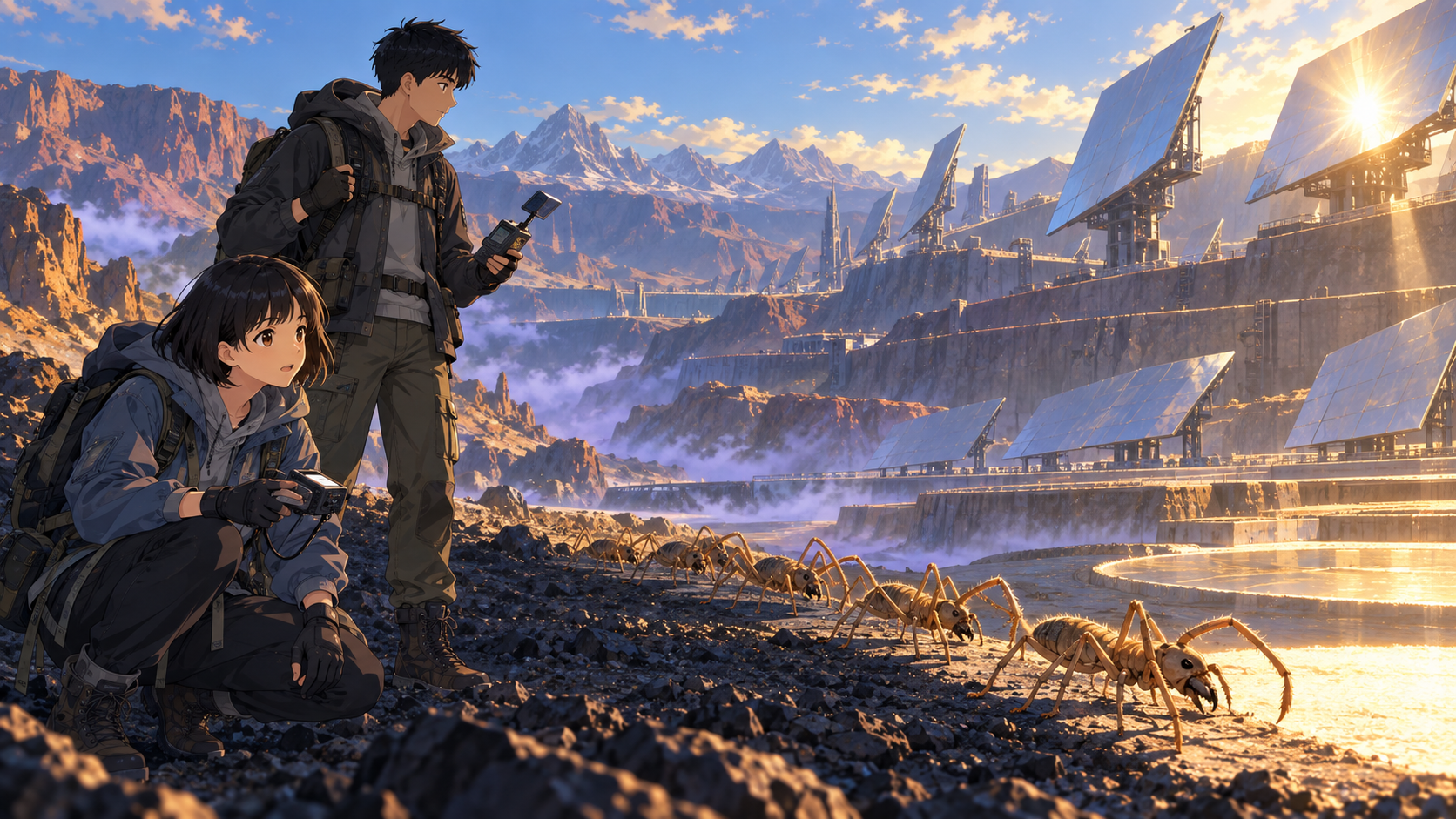
Thin mist from the night-cooled wells still clung to the black-glass gravel when we reached East Mirror-Trace Slope. Fang first saw a line of small ochre forms moving quickly along the edge of a shadow. I shut down active scanning and kept only the passive light meter running. The Lightbreak Solifuges stayed inside complete shade, long pedipalps testing the ground ahead. Then the entire line stopped at once. Forty-one seconds later, a heliostat hotspot swept across the path before them.
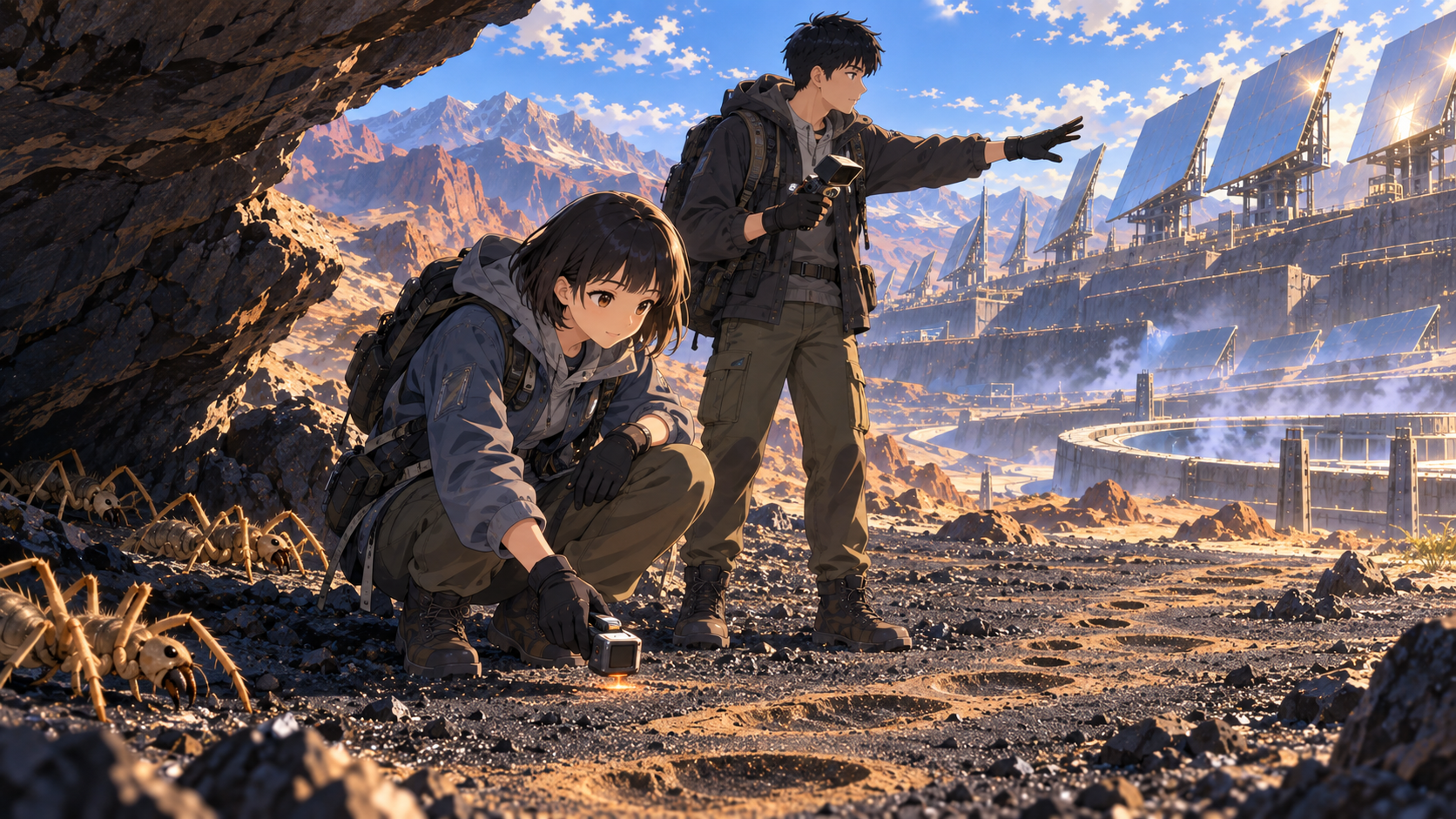
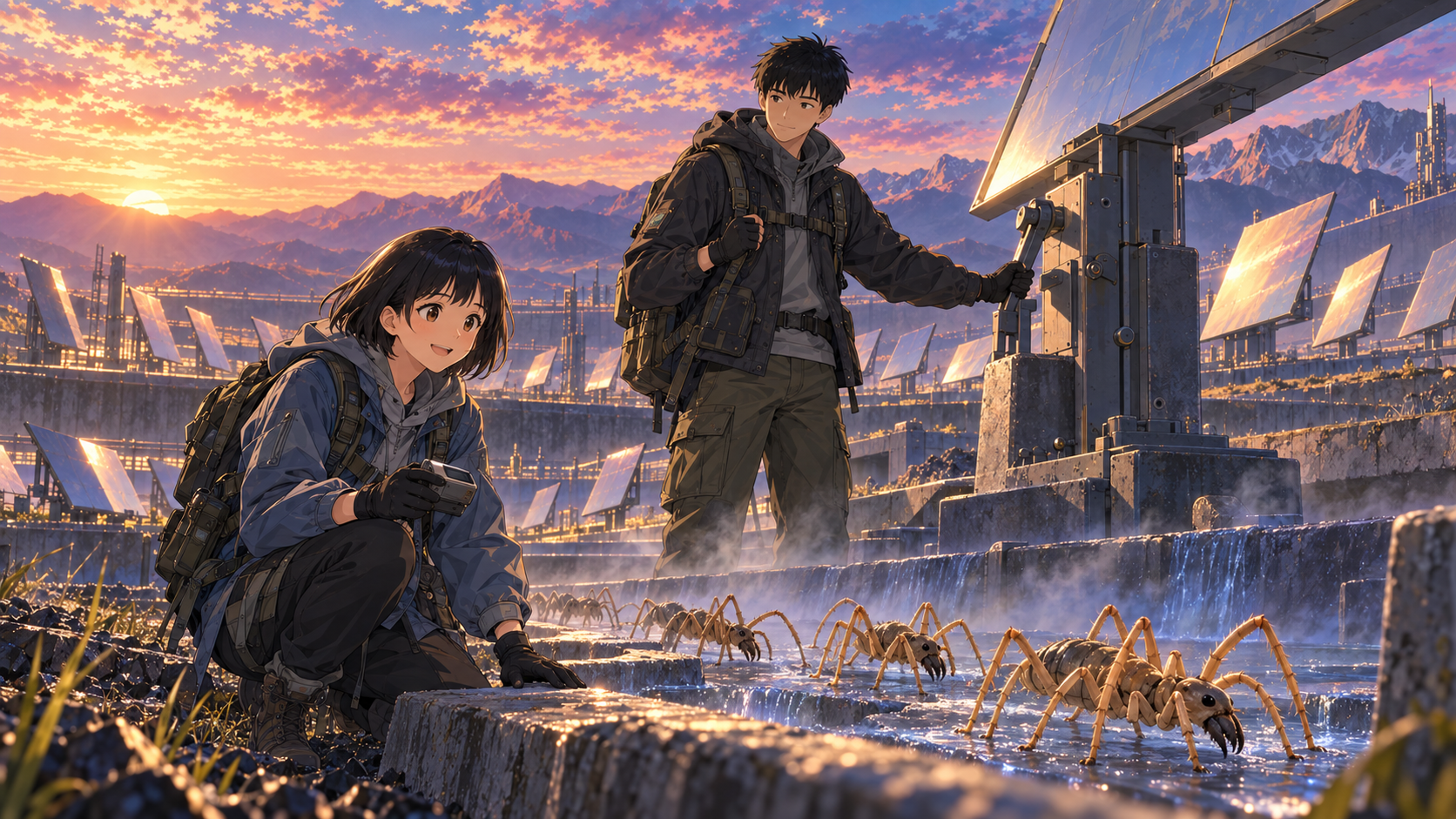
MORNINGWe had not startled them. They had read the surface-temperature change before the harbor's overheat alarm. Fang crouched beyond the activity line and placed her sampler close to the stone. I stood between her and the mirror field and marked the moving line of light. There was no visible hostility in the mirrors, only an automated program that had gone uncalibrated for too long. Fang told me to remember the stop rhythm: pedipalps raised, forelegs drawn back, body lowered, then the entire line waiting for the hotspot to pass. Without touching an animal, that rhythm gave us the hotspot's speed and preserved the first safe stretch of shadow toward the cold fissures.NOONThe fault became obvious at noon. Foot-pad marks ran straight and evenly spaced inside complete shadow, then broke sharply toward cool stone wherever the hotspot had crossed. Fang and I left one measurement line on each side. She read the ground-temperature difference with a noninvasive probe while I overlaid the turning times of three mirror frames on the footprint sequence. Every change of direction came before the mirrors moved. The solifuges were not chasing light; the old controller was misreading living shadows. Several adults remained beneath a rock shelf, their pedipalps testing toward us without approaching. Fang said the tracks were enough. I put away the barrier net and kept only the passive record. We marked three bends outside the activity boundary. No animal had to carry the burden of a human verification test.EVENINGWe worked on only the misaligned mirror row beside the trough. I locked its tracking axis at neutral while Fang observed from beyond the cooling stones. We moved no solifuge. The first adult touched the cool stone with its long pedipalps, then set all eight legs down. The others followed one by one through the same shadow. When the last crossed the trough mouth, the broken hotspot-warning trace became continuous again. Fang labeled the change 'passage restored,' not 'target cleared.' I did not argue. With one fewer living shadow under pursuit, the cold wells could retain a small hunting route for the animals that would come after. My weapon never left its securing strap. That was closer to repair than any victory.
「The habitat did not need to endure one more startup test so we could prove we were right. I recorded the mirror lock as a reversible correction and left the final review to the harbor engineers.」— K
Day 02 / 09.25
Where the Cold Air Returned
Cool-Fissure Elephant ShrewLow Risk
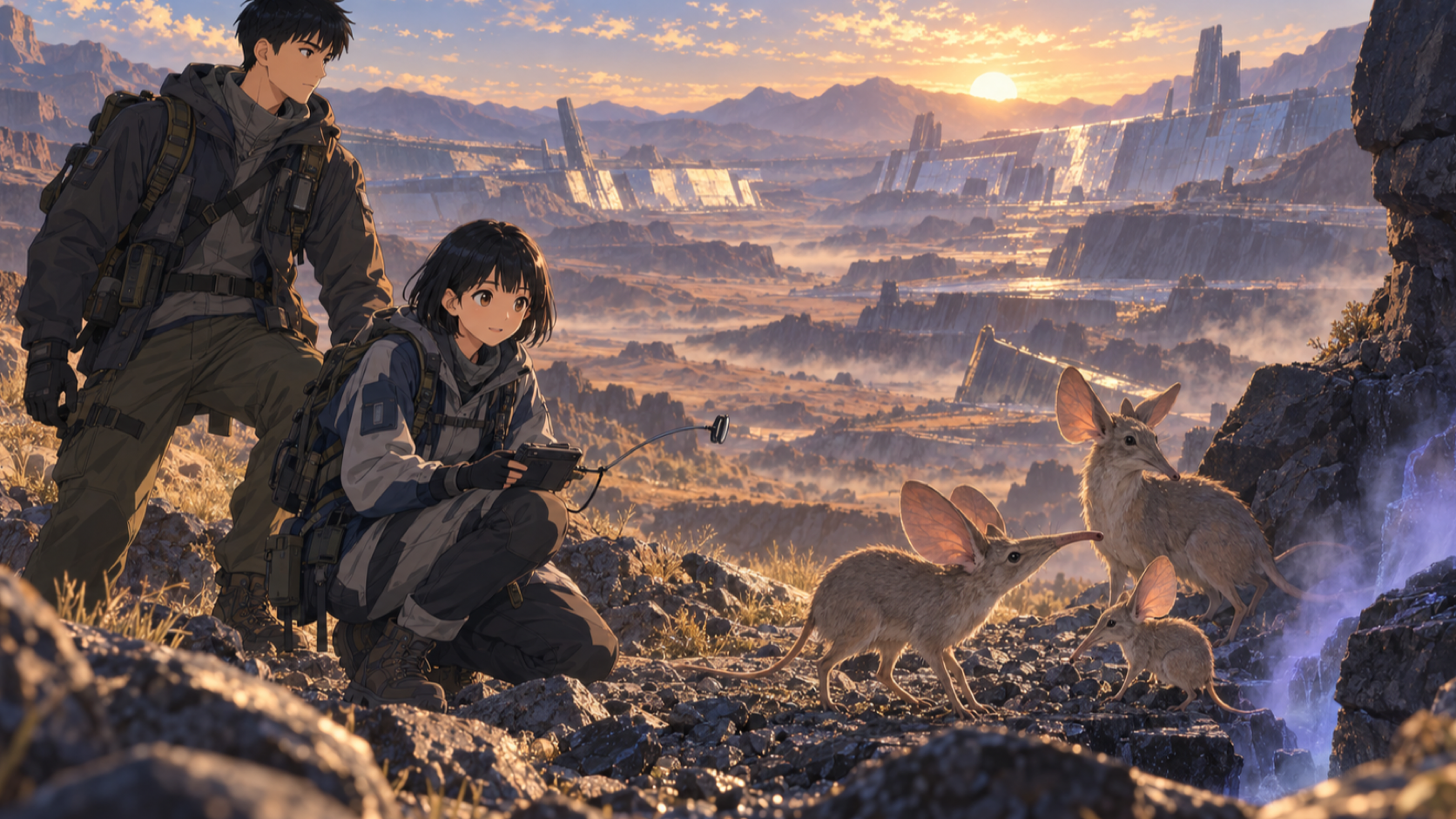
The change at Cool-Fissure Vent appeared first in the elephant shrews. A small family had gathered outside the blocked opening. Broad ears turned toward every broken pulse of cold air; long noses followed, testing the gaps between stones. Fang set her instruments beyond their activity line. I shut down anything active and looked for the human-made obstruction. We did not need to make the animals move. Their attention had already drawn the map.
MORNINGThe adults were roughly half a meter long, sand-gray, with fine tails and hind legs held ready beneath them. A palm-sized juvenile stayed behind the other two. They were not waiting for us. Each time a faint draft reached the opening, one adult raised its broad ears while the other worked its nose along the stone seam. When the airflow failed, both returned to the same point. Fang measured from outside the boundary and marked the intervals. I kept myself between her and the mirror terraces, with my weapon secured. The pattern said there was still cold air below us. Something at the outlet was keeping it from becoming a continuous route.NOONWe followed the shaded side of the fissure, not the family. Fang found dew where the stone should have been dry, then solifuge traces and empty insect shells near the same narrow gaps. Seeds clung to the lower fur of one adult before it slipped back into shade. The signs matched the corridor's ecology: small prey used the cooler seams, and the elephant shrews carried dry-valley seeds into places that collected night moisture. My instruments found the interruption farther ahead. A heat-storage wall from the mirror field crossed the branch, and a removable grille sealed its mouth. Fang had enough measurements. I did not open the route while the animals were standing beside it. We backed away first.EVENINGI released only the human-made grille. We changed no stone seam and touched no animal. Cold air moved through the vault again, weak at first, then steady enough to lift dust from the shaded floor. Fang and I withdrew to the observation line. The first adult tested the opening with its nose. The second turned both ears into the draft. The juvenile waited until they had crossed, then followed. Seeds brushed from their belly fur into a damp crack on the far side. Fang recorded the branch as open. I recorded the correction as reversible. Neither of us called the family back for a second pass. The route belonged to them again; confirmation was their choice.
「A blocked habitat does not need a louder signal. Sometimes the smallest animals are already pointing at the failed machine. Our part was to listen, change only what people had installed, and step back before the cold air returned.」— K
JOURNEY DISPATCH
Subscribe to K's Hunting Log
Follow Fang and K into a world that has not yet been understood.