K's Hunting Log Fiction · Week 1
The Road the Tide Remembers
Outside Vancouver Dome, K and Fang follow mirrored wings, crystal antlers and a deepening call through Tidal Echo Wetland, searching for a way home.
Listen to this story
19 min 24 secMK as K and narrator · Dorami as Fang
AI-generated voice performances.
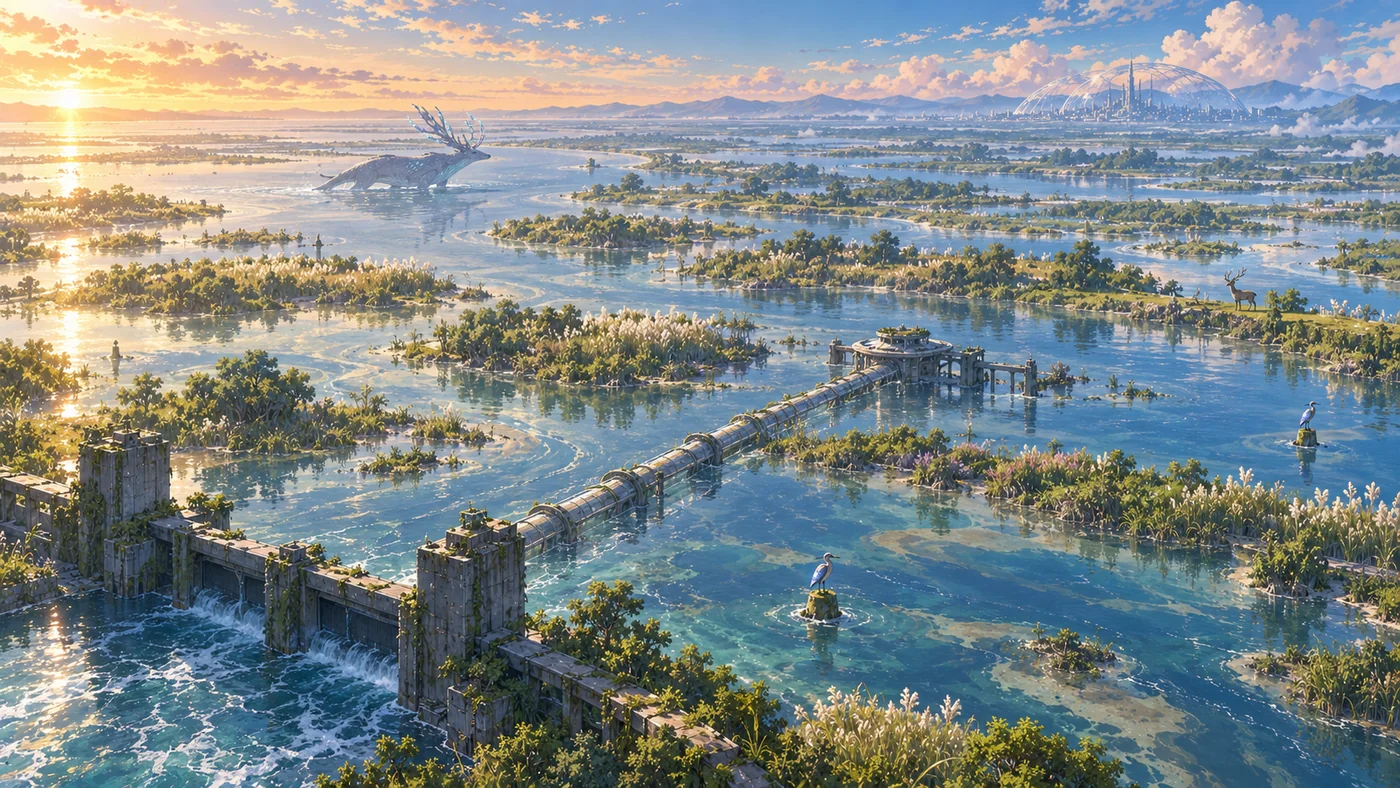
Southwest of Vancouver Dome lies a wetland whose roads appear only when the sea retreats. On clear days, flocks of waterbirds wear mirror-bright feathers, folding the dome's morning light into the shallow bays; at night, the transit tubes and maintenance towers beneath the water begin a low murmuring, the sound traveling through the metal framework underfoot. Wherever you walk, it feels as though something is following, deep below the ground.
Before we left, I thought the hardest part would be remembering which paths disappeared at high tide. Fang kept listening to the recording that had unsettled an entire maintenance station, then finally took off her headphones and asked me something that had nothing to do with the briefing.
“K, do you think it's been waiting out there for a long time?”
I didn't yet know what she meant by “it.” Five days later, when that enormous shadow finally stopped before the sealed tide gate, I was grateful that, this time at least, we hadn't made it keep waiting.
By the time we reached Outer-Ring Maintenance Station, nobody there had slept well for seven nights.
The sound always came through the foundations after dark, first drawing fine ripples across the water in people's cups, then climbing the pipes inside the walls. Sometimes it resembled a distant ship; sometimes it was as though something enormous were breathing slowly beyond the coastline. On the fourth night, the automatic floodgates began misreading the tide level. On the sixth, two passages closed in succession. On the seventh, the station finally decided to bring someone in.
They gave us a recording and a map of the affected locations.
“Can you make it stop?”
Before I could answer, Fang already had her headphones on.
She stood beside the window and listened to the same sound three times, the calibrated morning light outside falling across her profile and making her intent eyes seem unusually still. Only when someone at the station asked again did she take off the headphones.
“Have you tried finding out what makes it stop?”
“It gets a little weaker after the tide goes out.”
“I meant apart from the tide.”
No one answered.
I looked down at the map. Every red mark was on a human structure. Apart from those, the wetland occupying more than half the sheet was almost blank.
After we left the station, Fang listened to the recording once more before asking the question I didn't quite know how to answer.
I looked toward a railing in the distance, only its upper half still visible.
“You're already sure it's alive?”
“Not yet.”
She put away her headphones and settled the sensor pack on her back.
“That's why we need to go and look.”
Beyond the dome's boundary, salt wind passed over the flooded embankments. The white lines of an old road were faintly visible underwater, stretching into places the light couldn't reach. Fang walked along the stones, stopping now and then to study something in the water, while I kept trying to decide whether the stone she meant to step on next was still a stone.
What first stopped us was a sheet of white light suddenly changing direction.
Dozens of Mirrorwing Tide Herons stood on maintenance buoys, the adults' feather plates reflecting the dome's morning glow. In the wind, the flock became a row of mirrors turning slowly, sending fragments of light into the shallow bay. Fish were driven toward the shore. Young birds peered from beneath the adults' wings, their mist-white feathers not yet mineralized, looking almost disproportionately small inside all that dazzling silver.
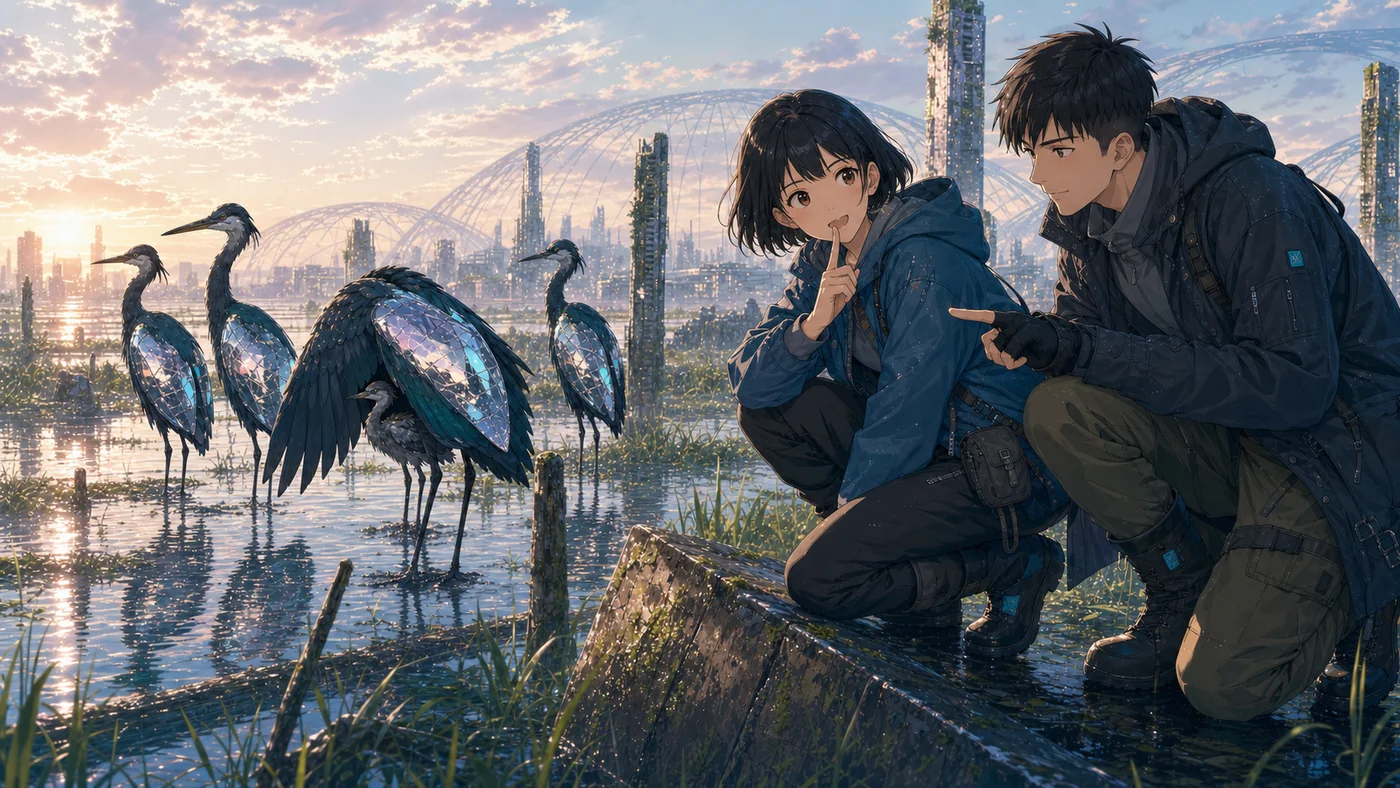
When Fang crouched, one adult immediately spread half a wing.
I covered the reflective buckle on the sensor pack and moved two steps outward, keeping her in my shadow.
“It's warning us,” she said quietly.
“Message received.”
“I mean you don't have to look more eager for a fight than it does.”
I relaxed my shoulders.
After a while, the bird folded its wing too.
Had that been the end of it, I would have recorded them as waterbirds with little patience for visitors. But by afternoon the wind had turned seaward, and they still kept lifting their heads toward the wetland's interior, as though waiting for instructions we couldn't hear.
Fang followed their gaze for a long time.
“What's over there?”
I opened the map and found a submerged causeway, a disused pumping station, and, farther away, the old tidal station.
“A lot of things that should have been dismantled years ago.”
She glanced at me.
“Let's go and look tomorrow.”
That evening the herons lifted from the buoys one by one, silver wings passing over the darkening water, all in the same direction. Watching from the embankment, I began to think the map the maintenance station had given us might have left out the most important things.
Over the next two days, we followed animals that couldn't read maps and found paths that weren't on ours.
The Saltvein Antler Deer led us off the causeway first. They moved slowly through the salt-stunted grass, licking mineral flakes from the concrete. Every so often the leading stag stopped and tilted his translucent crystal antlers toward the ground. At first I thought he was wary of machinery vibrating below us. Only when Fang crouched across the channel and pressed a sensor to the embankment did we hear the tidal pump still running underground.
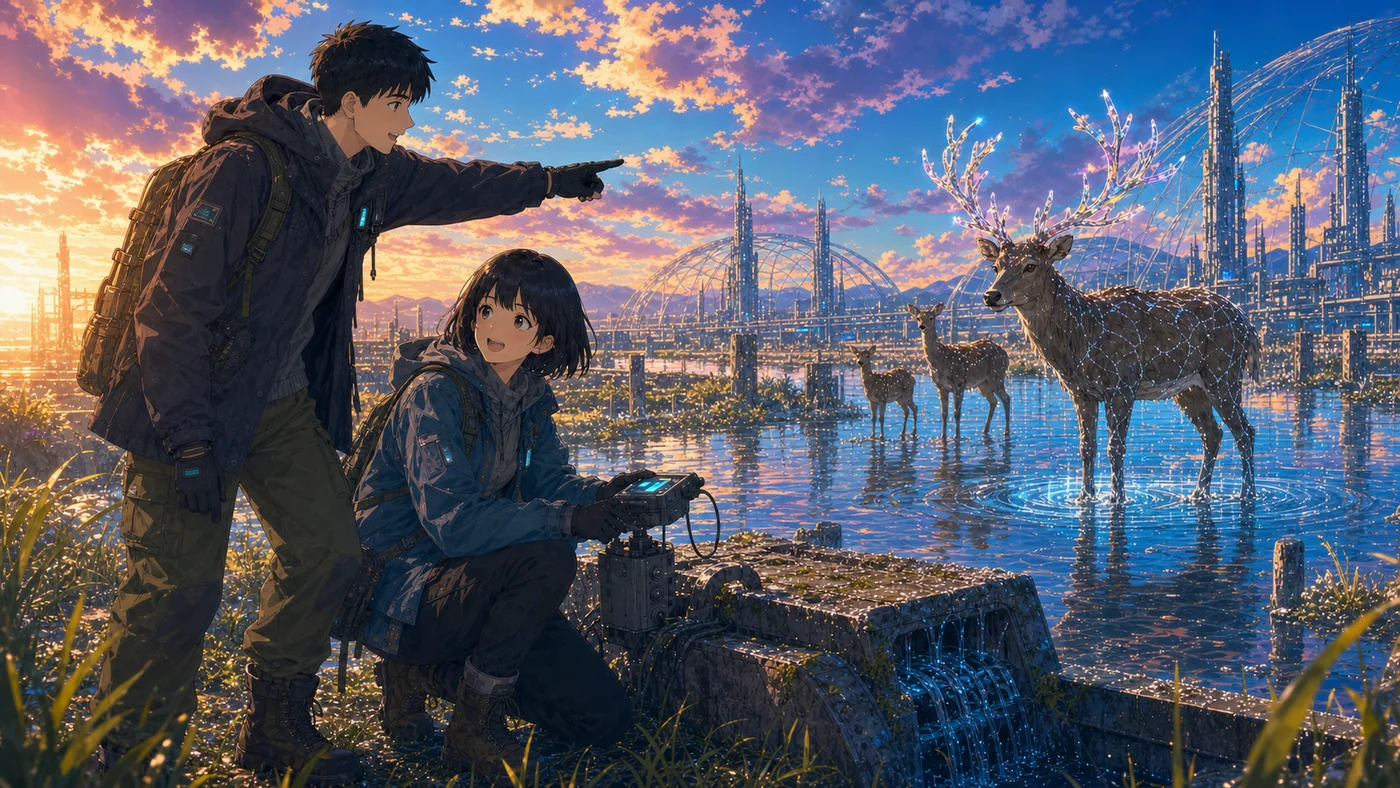
The pump's rhythm was regular and clipped, easy to recognize.
Another sound came from farther down, with pauses so long you almost believed there wouldn't be another. Each time it returned, the stag raised his head, and the deer that had been feeding turned with him.
Watching them, I suddenly remembered yesterday's birds.
Fang didn't rush to offer a conclusion. She overlaid the two recordings and motioned for me to listen. As the low-frequency echo reached my headphones, the stag across the channel tilted his head a little too, his crystal antlers catching the light for an instant.
I drew back the foot I had been about to put across the channel.
Behind the herd, an antlerless fawn emerged from the grass and pressed close to an adult's belly as they followed the higher ground. Their route took one more bend than the embankment line on the map, but avoided the concrete that had already been hollowed out underneath.
Fang looked from me to that stretch of causeway.
“Follow them, then?”
“At least they've used the route once today.”
On the third day, we found more responses inside Sunken Transit Tube.
Members of the Sunken-Bell Frog Chorus covered the damp inner walls, translucent sacs on their chests swelling with the water pressure. After the first low call, the sound traveled along the tube, one section after another, until all the metal beneath our feet began to tremble.
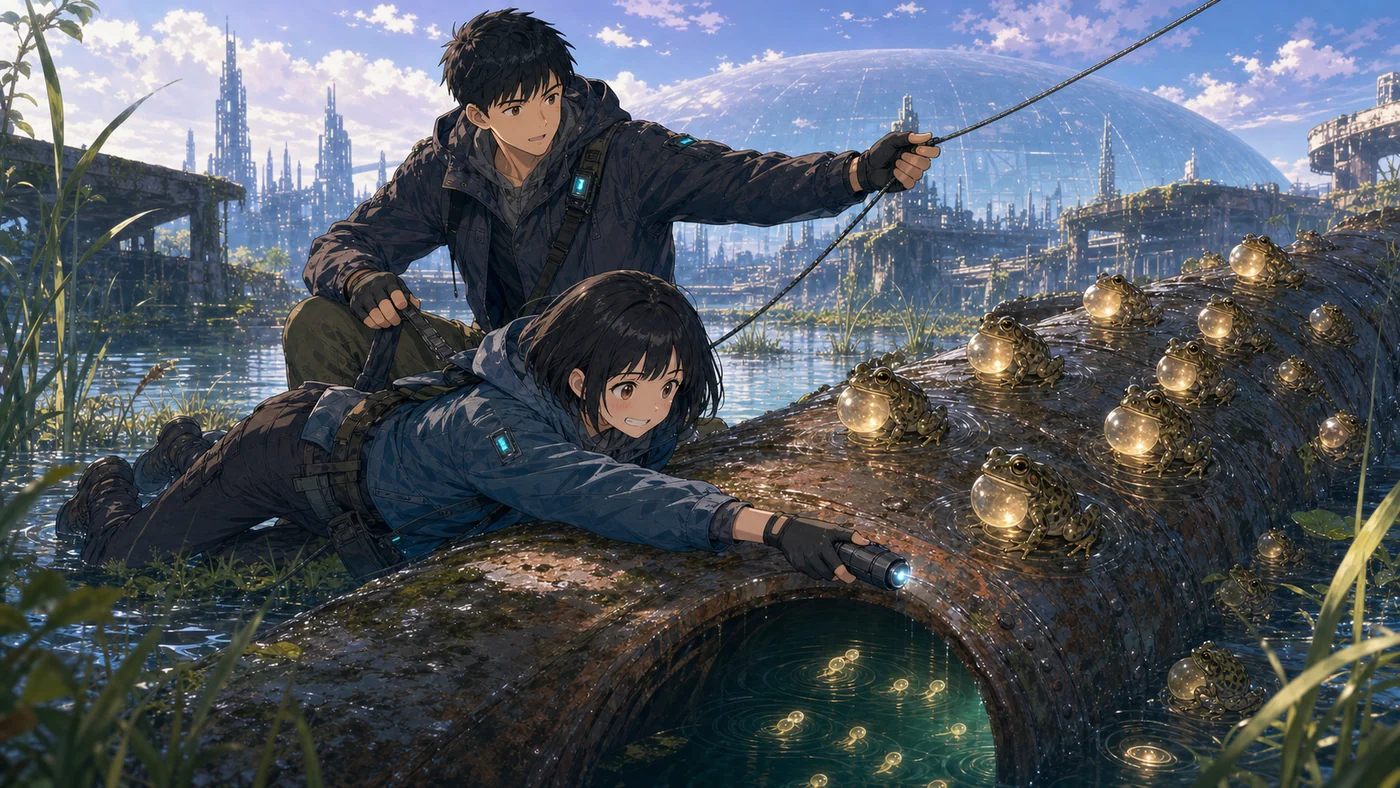
Fang leaned forward with the sensor while I tightened the safety line behind her. She had just obtained a complete set of readings when a corroded fastening ring came loose overhead, grazed the tube's rim, and fell into the water at our feet.
“Out,” I said.
She didn't argue, just withdrew the instrument and followed me back to higher ground. Once my footing was secure, I looked back and saw the place where we'd been standing swaying in the water. Rust sifted down in layers with the frogs' calls, as though that length of tube had finally begun admitting its age.
Fang braced her hands on her knees and took a few breaths. When she looked up, there was a light in her eyes I knew well.
It usually meant we weren't going back yet.
“They're answering it, K.”
She played the recording for me. A deep call traveled through the pipes; the frogs' chest sacs pulsed in response, and dense ripples spread over the water. Passing through the pumping station, the embankment foundations and the submerged buildings, the sound was reflected, amplified, and fed into the maintenance station's sensors, until it became a series of alarms the system couldn't classify.
I looked deeper into the wetland and tried, for the first time, to imagine what we still hadn't seen.
How large did it have to be for so many lives to stop and listen?
“If it can't find a way through,” Fang said softly, “it might just keep calling.”
By then the tide had covered the low embankment on our return route, leaving us to wait on higher ground. Fang kept replaying the recording. I secured her safety line again and didn't hurry her to put it away.
Another call came from the distance, longer than before.
What finally showed us what that gate was keeping out was a young animal that couldn't get back onto its mother's shell.
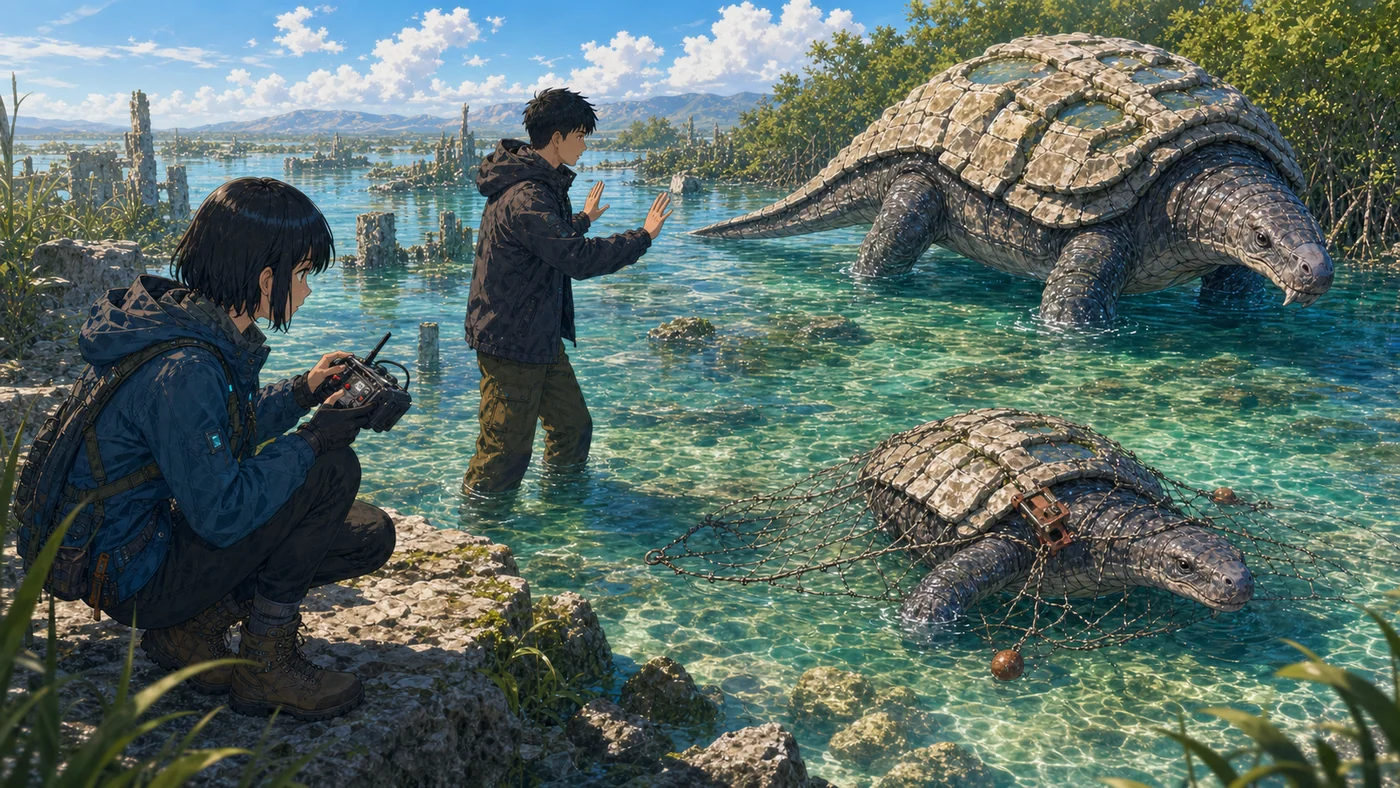
It was caught in an abandoned maintenance net at the mouth of the bay, its small blue-gray body rising and falling with the waves, every stroke tightening the mesh. A Tideshell Matron stayed beside it, slowly turning six meters of body toward us. The other young huddled on her back shell, freshwater running from the grooves along its edge into bay water white with salt.
I stopped. So did Fang.
The mother watched us without roaring or charging. She only moved a little closer, and water washed over the stones beneath our feet.
I knew I couldn't stop her.
Fang knew too. She stood still and slowly lowered the instrument in her hand, waiting for the mother to turn back to her young before tracing the net to its fastening mechanism.
With the tide gate closed, their old waterway was no longer passable, and the mother had been forced to bring her young through the abandoned facilities. The maintenance net had probably soaked there for years, only becoming noticeable again when something was finally caught in it.
“I can release it,” Fang said.
She didn't look at me. Her eyes never left the mother.
I moved to one side, giving her room to work and keeping my hands where the mother could see them.
As the first clasp came free, the young animal struggled sharply. The net drew tight at once, and the mother turned toward us in the same instant, coming closer.
A wave struck the embankment. Behind me, I heard stones fall.
“Stop,” I said.
Fang's hand hovered over the interface.
The mother's head was close enough for us to see the droplets on her nose. The young on her back shifted uneasily; one slipped, then pressed itself flat against the shell again. Fang held her breath. I watched the water around the mother's feet and waited for the ripples of her advance to spread and fade.
Neither of us moved again.
Only when the trapped youngster stopped struggling did the mother turn a little aside.
Fang waited for the opening, then released the remaining clasps little by little. As the final length of net sank, the small animal paddled a few more strokes in place, as though it hadn't yet understood that it was free. Then it suddenly went forward, around its mother's side, and climbed onto the shell that had been waiting for it all along.
Fang lowered her head and let out a long breath.
Only then did I notice that one hand had been gripping her sensor pack's strap the whole time, her knuckles white.
After the mother left, we sat beside the bay for a long time. Fang checked the route to the tidal station again. I handed her water and watched her drink a few mouthfuls before looking away.
The gate symbol on the map was small.
Too small to show what it could keep from going home.
Early on the fifth morning, Fang stopped me.
She pointed nowhere, only raised a hand for quiet.
A faint tremor passed through the elevated structure beneath us. Then the water outside the submerged station slowly rose, a ring of ripples crossing the broken walls and pushing floating grass toward our feet.
The crown horns emerged from the mist first.
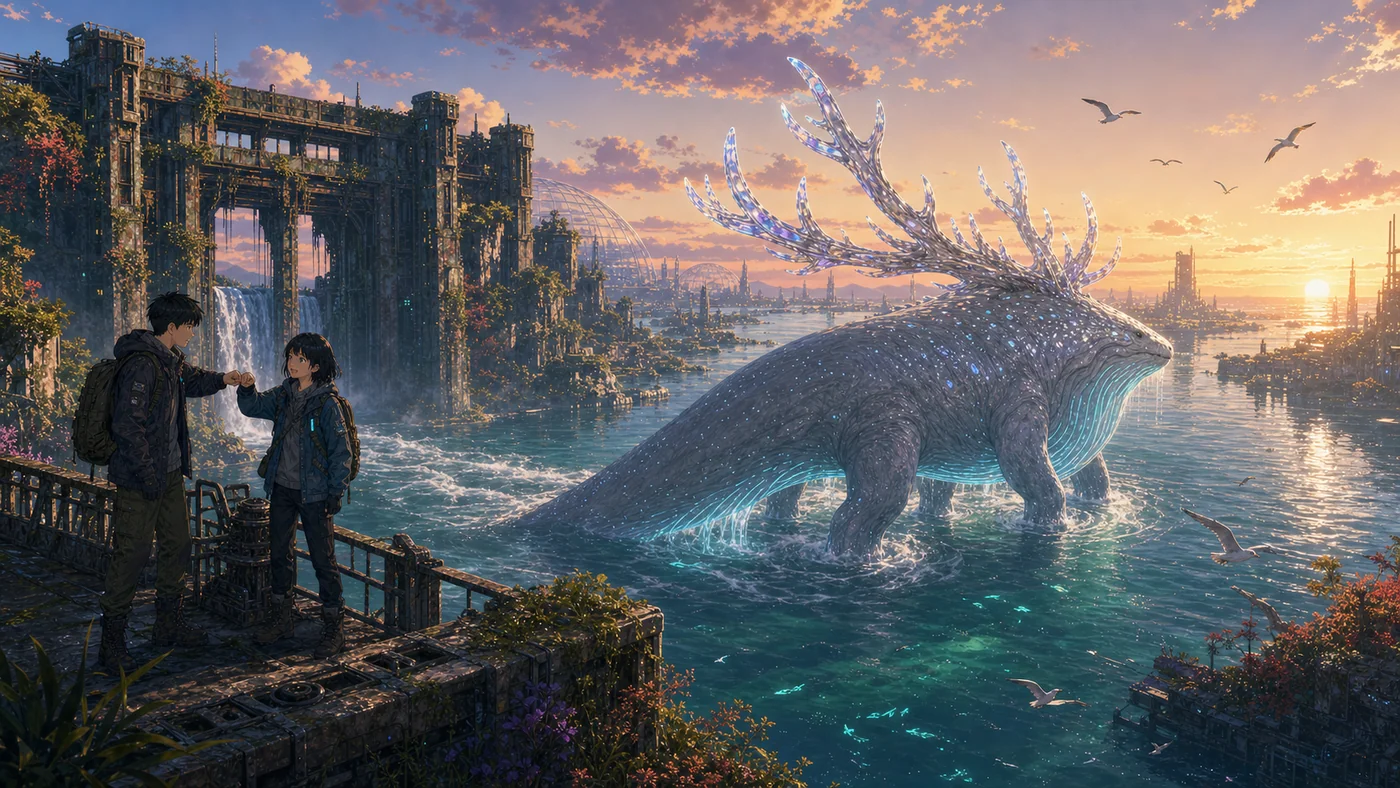
Then came the broad head, the throat pleats glowing pale turquoise, and a body even larger than I had imagined. As the Sky-Tide Crownwhale stepped into the shallows, its four pillar-like weight-bearing limbs settled one after another, parting the water along its belly. Eighteen meters was simple enough in a data field. When it actually stopped before us, I checked where Fang was again.
She was staring at it, lips slightly parted. Several seconds passed before she drew a breath, as though finally remembering she needed one.
The crownwhale stopped at the sealed tidal passage, lowered its head, and gave a long call.
The entire tidal station rang with it.
The buckle on my chest trembled gently. Scattered replies came from the frogs in the distance, but the crownwhale stayed before the gate, waiting for the sound to travel around the wetland and return.
At last I heard what the recording hadn't kept: after the sound ended, it waited a long time before calling again.
Fang chose a platform above the high-tide level and activated her BCI. I checked her escape route and secured the safety line before heading for the controls.
The automatic system was still treating the low-frequency echoes as abnormal tide levels and refusing to open the passage. I switched to manual operation and tried the lever. The corroded mechanism scraped harshly, but the gate only shuddered once.
In my earpiece, Fang's breathing suddenly deepened.
I stopped moving the lever.
“Fang?”
She didn't answer immediately.
I looked back and saw her at the other end of the raised walkway, one hand on the railing, her shoulders tight. The crownwhale's throat pleats brightened and faded. Its low call was passing through the water and the station, and through the sensory input she was receiving.
“Fang, answer me.”
“I'm here.”
Her voice was very quiet.
“It isn't going to charge us… it keeps looking for the entrance.”
I looked toward the gate. One step forward, and the old structure would have to bear forces we preferred not to calculate. Yet the crownwhale stayed still, its enormous head tilted a little toward the channel, waiting for an echo that never came.
“How much longer can it wait?” I asked.
“I don't know.”
Fang raised her head and looked at me.
“Let's be quick.”
I gripped the lever again and worked the resistant mechanism past the place where it had seized. A heavy sound came from the base. Something shuddered underwater, and the gate that hadn't fully opened in years finally began to rise.
Water surged beneath it first, a narrow line widening rapidly. The accumulated grass was drawn into the channel, uncovering stones long since worn smooth.
I watched the water level. I watched Fang too.
She steadied herself and raised a hand toward me.
The crownwhale didn't move at once. It turned its acoustic crown toward the far end of the passage and stayed still a moment longer. Only when a different echo returned from beyond the gate did it slowly take its first step.
In that instant, Fang smiled.
I saw her expression across all that rushing water and suddenly felt there was somewhere to set down the wrong turns of the past five days, the mud we'd stood in, and every wait that had tested our patience.
The crownwhale passed before us, its broad body blocking the morning light. The turquoise glow in its throat pleats lit the tidal station's broken walls, then receded with the water, inch by inch. Deep vibrations followed its footsteps. I stayed at the console until the last silhouette had cleared the gate, and only then did the sound pressing against my chest begin to ease.
“K, that's enough.”
Fang's voice had returned to its usual volume.
I let go of the lever and realized my teeth had been clenched the whole time.
That evening, we sat on the embankment on the way back, waiting for the water to drain from our boots.
The ancient tidal channel had a current again. In the distance, Mirrorwing Tide Herons settled back onto the buoys, and the deer crossed the grass on higher ground. The directions we had recorded separately were finally joining up within the same wetland.
Fang hugged the sensor pack and leaned against the stones, saying she only needed a moment's rest.
A few minutes later, her head slowly drooped.
I took the instrument she hadn't yet put away, laid my jacket over her shoulders, and moved our return time back half an hour. The station messaged to ask whether the interference had been cleared. I looked at the open waterway and replied that the tide gate was working again; the detailed report would follow later.
Asleep, Fang took being a person of few words very seriously. At last I had a chance to finish a sentence.
I looked along the tidal channel as it slowly darkened and quietly opened my log.
“Before we left, I thought this job meant finding the source of a sound, then deciding what to do about it. Later I realized I could calculate a gate's load capacity very precisely, yet had never thought about how many lives might still be waiting outside once it closed.”
Wind skimmed the water. I reached over to hold the jacket that was about to slip from her shoulder.
“Fang didn't ask me today what it felt like to hear a whale sing. She probably thought I was too busy opening the gate to listen. But I heard it. From the first day until today, I kept hearing it. Only when it went through did I understand how much of the strength in that voice had been spent waiting for us.”
She stirred in her sleep. I paused until she settled again.
“I'm glad we made it in time. In time to undo the net, in time to open the gate, and in time to still be somewhere she could see me when she turned around. I don't know how many more paths like this I'll get to walk with her. But the next time she stops and says there seems to be something over there, I think I'll follow her again. Even if it takes us a long way around. Even if all I end up doing is sitting with her on the shore, waiting for a young animal to climb back onto its mother… I would still want to.”
I stopped the recording and sat on the embankment a little longer.
By the time Fang woke, it was dark. Looking a little embarrassed, she handed back my jacket and asked why I hadn't woken her.
“The tide hasn't gone out far enough,” I said.
She looked down at the path that had long since appeared, then looked at me.
I shouldered my gear and went down the embankment first, offering a hand for her to steady herself.
“We can go now.”