Cool-Fissure Elephant Shrew
The elephant shrews probe fissures with mobile noses, search for solifuges and insect remains, and use broad vascular ears to shed heat. Drought-tolerant seeds cling to their belly fur and are carried into shaded fissures that collect night dew. At a blocked vent, a family alternates between listening with its ears and testing the broken airflow with its nose. Once the grille is removed and cool air returns, the animals choose the route themselves.
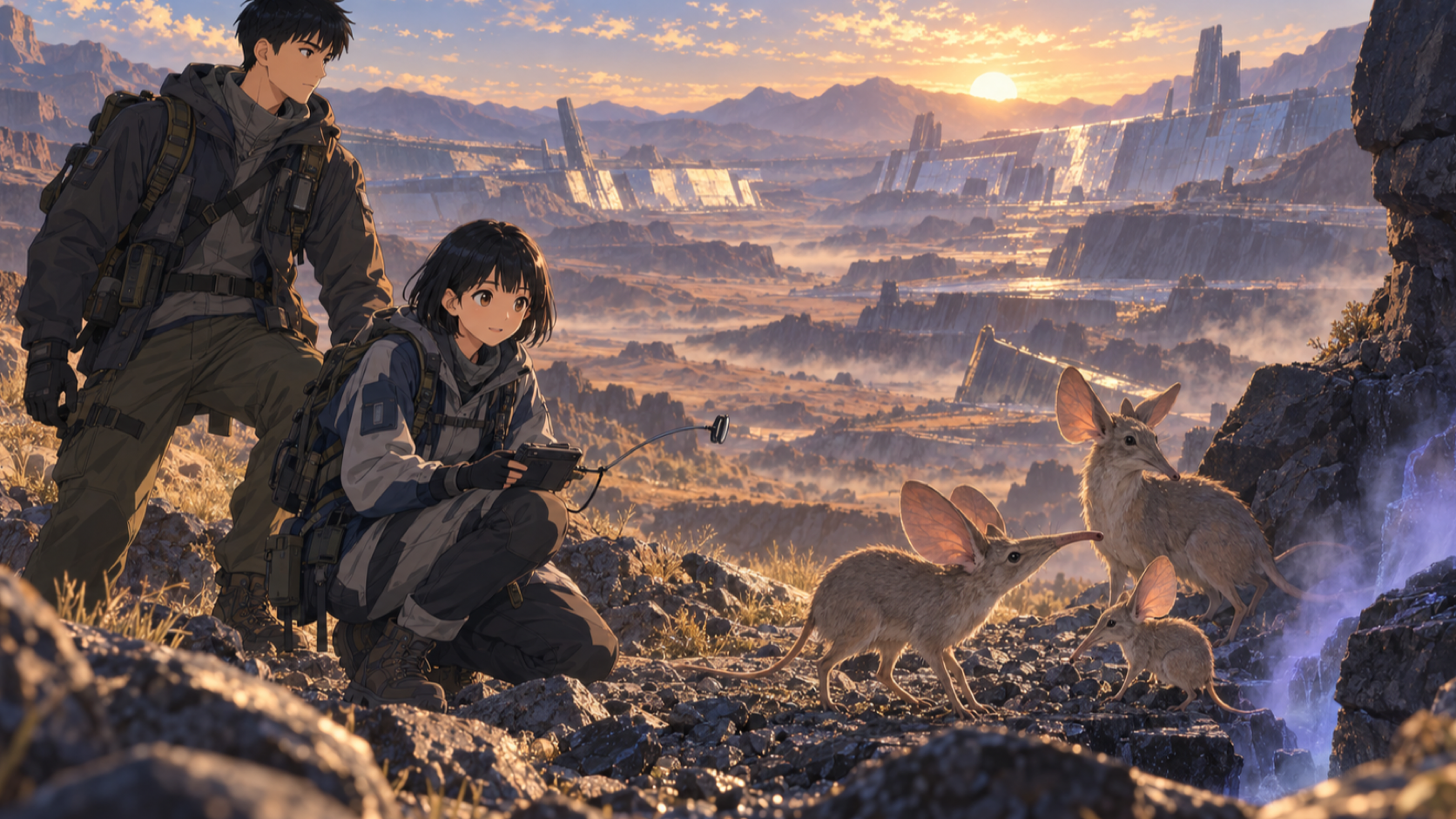
Observation LevelCoastal field note
First SeenDay 02 · Day 02 · Cool-Fissure Vent
HabitatCool fissures, dew-bearing stone crevices, underground cooling branches, dry ochre slopes, black-glass gravel, weathered solar-mirror terraces, and three night-cooling wells within the Lights-Out Cold-Well Corridor
VariantsPalm-sized juveniles with shorter noses, half-meter sand-gray adults, and small family groups of two or three sharing a dew vault
Habitat and Mechanism
Cool fissures, dew-bearing stone crevices, underground cooling branches, dry ochre slopes, black-glass gravel, weathered solar-mirror terraces, and three night-cooling wells within the Lights-Out Cold-Well Corridor。The abandoned solar-mirror terraces gather heat by day. At night, the mirrors should lock into a lights-out angle so descending valley air can pass through underground tunnels and rise from three cold wells as the Night Cooling Return Tide. A restarted controller kept the field hot and left a heat-storage grille across one branch outlet. Cool-Fissure Elephant Shrews gathered where intermittent cold air still leaked through. Their position showed that the branch remained open below ground even though its mouth was blocked.
Enter Lights-Out Cold-Well Corridor ↗Behavior and Ecological Role
The elephant shrews probe fissures with mobile noses, search for solifuges and insect remains, and use broad vascular ears to shed heat. Drought-tolerant seeds cling to their belly fur and are carried into shaded fissures that collect night dew. At a blocked vent, a family alternates between listening with its ears and testing the broken airflow with its nose. Once the grille is removed and cool air returns, the animals choose the route themselves.
Their gathering direction maps underground branches that still carry cold air. By moving seeds from the dry valley into dew-bearing shade, they connect prey routes, seed sources, and the corridor's night-cooling cycle. Restoring the branch gives the animals access to their condensation vault without baiting, handling, or redirecting them.
Form and Identification
Palm-sized juveniles with shorter noses, half-meter sand-gray adults, and small family groups of two or three sharing a dew vault
- A biologically plausible sengi body rather than rabbit or canine anatomy
- A long mobile nose used to probe stone seams and prey traces
- Broad, thin, vascular ears that release heat
- Matte sand-gray fur, long springing hind legs, and a fine tail
- Small family groups gathered at intermittent cold-air leaks
Observation Rule
Fang and K do not chase, trap, touch, relocate, bait, aim at, strike, or use the elephant shrews as test subjects. Fang takes noninvasive measurements from outside the activity boundary. K changes only the human-made grille and keeps active systems and weapons secured. The family decides whether and when to enter the restored fissure.
At Cool-Fissure Vent, a small family waited outside the blocked opening. Broad ears turned toward each faint draft while long noses tested the gaps between stones. Fang measured from beyond the activity boundary. K kept active equipment off and traced the interruption to a human-made heat-storage grille rather than approaching the animals.